Return of the Buffalo | Amir Hamja
Two hundred and fifty years is not very long.
That thought kept coming back to Amir Nizar Zuabi as he listened to Karen Brooks Hopkins and Susan Feldman, two of Brooklyn’s most influential arts producers, talk about America’s semiquincentennial. “Every time they said 250th, I went: it’s such a short time. It’s such a baby time,” the Palestinian director told me. “Coming from where I come from, from this ancient, ancient land… but the land here is ancient too. And the land had people.”
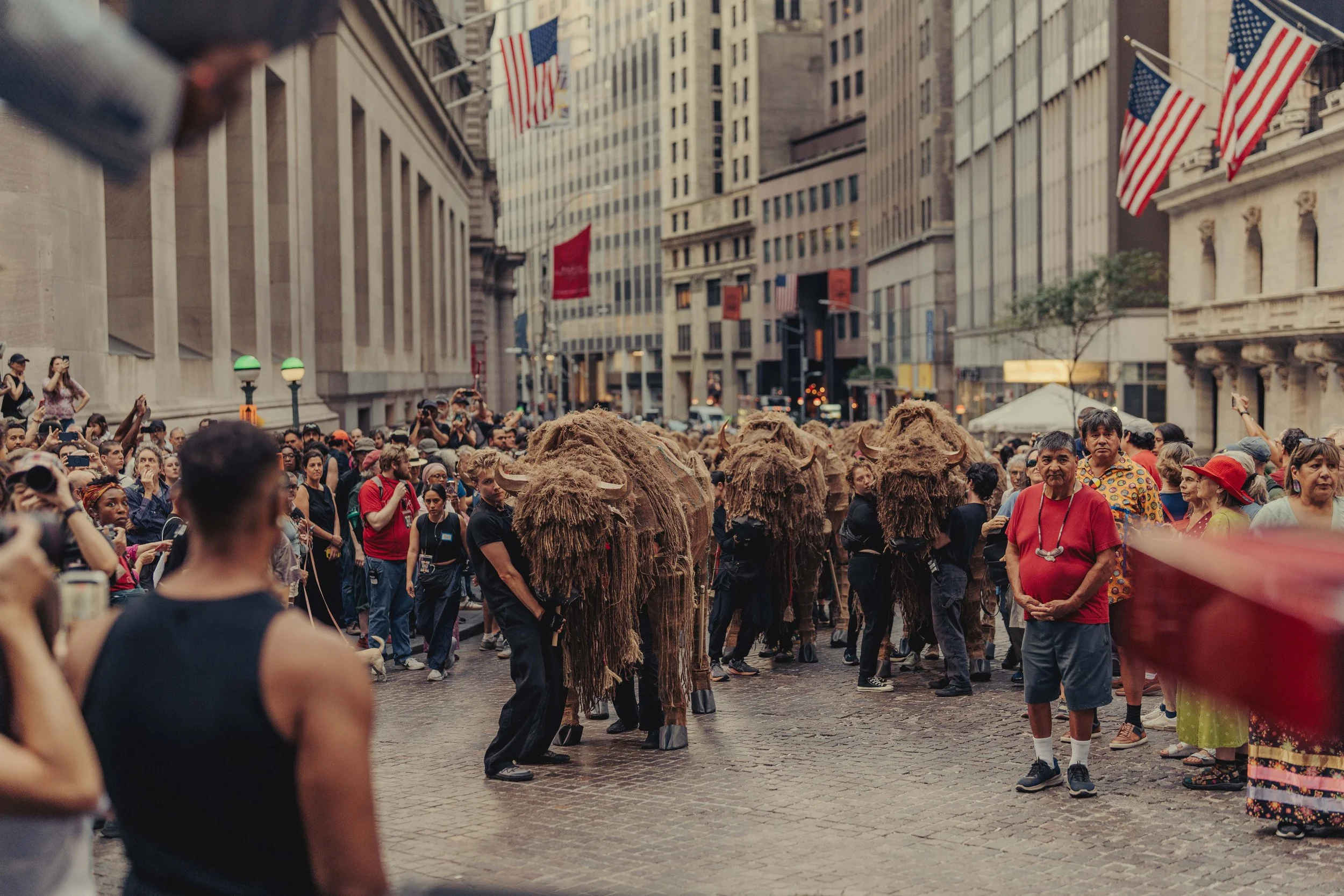
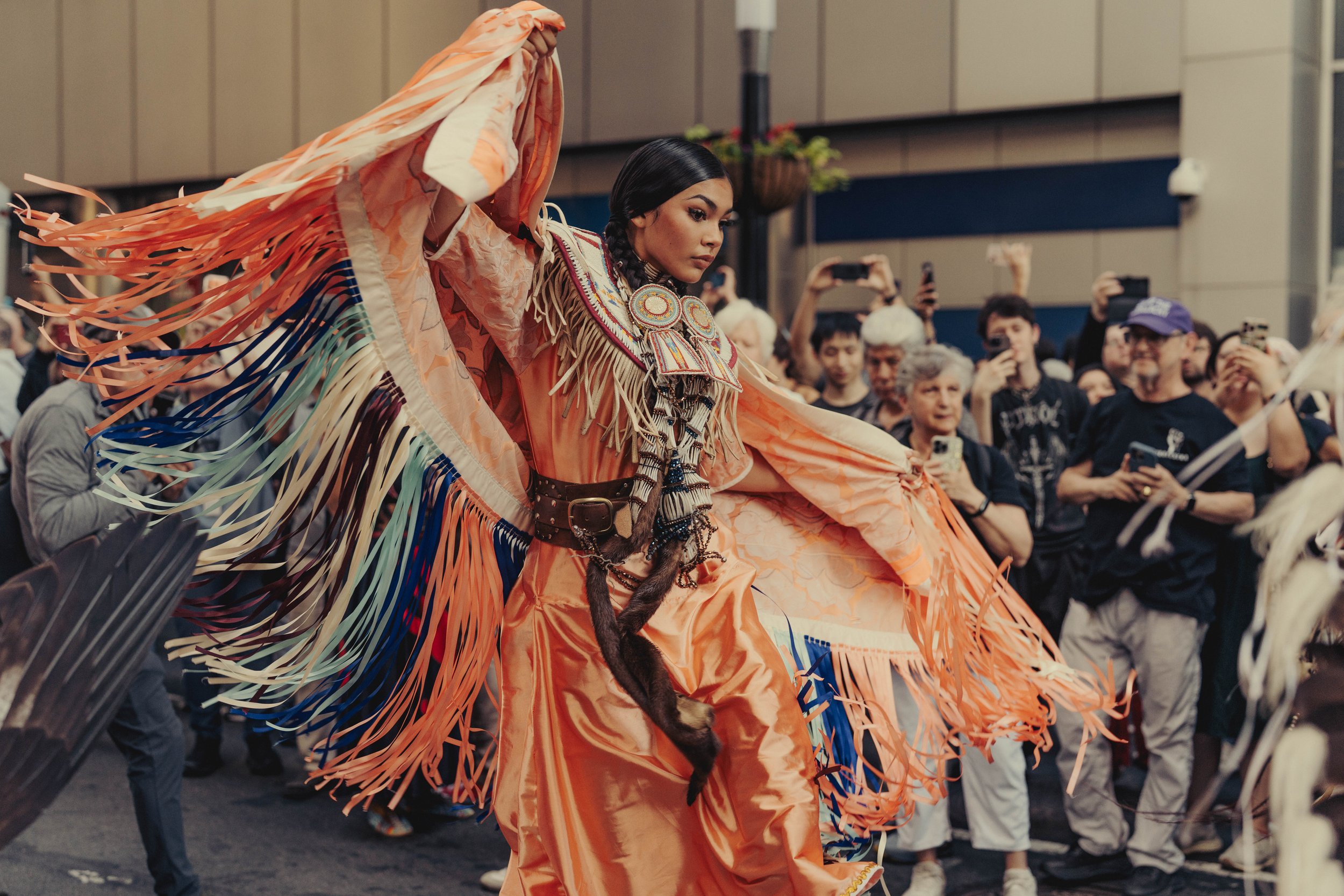
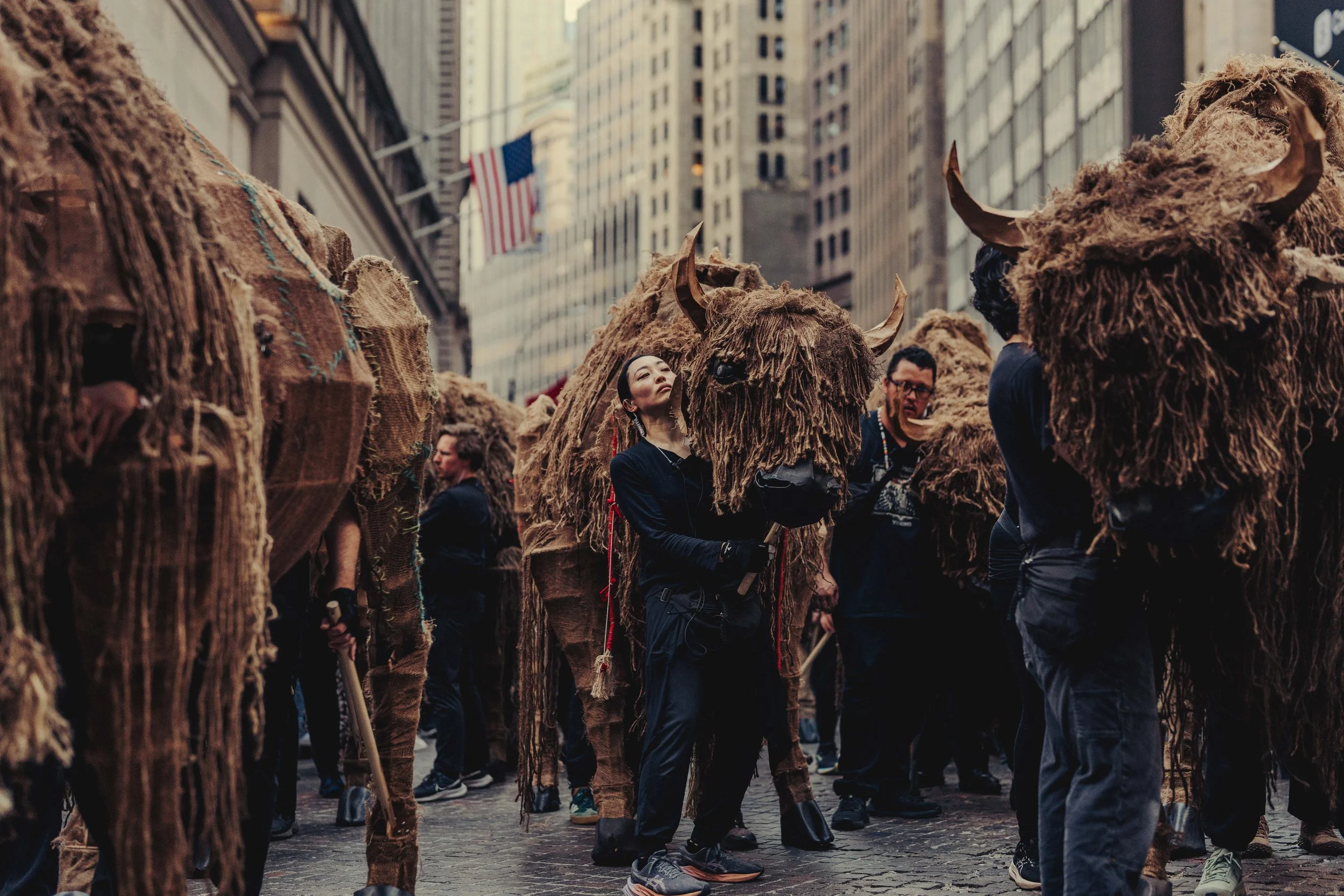
What followed was one of the most ambitious works of public art New York has seen in a generation. This September, a herd of life-size bison puppets stampeded through Lower Manhattan and Brooklyn over two days. They were built from cardboard, natural and recycled materials and a mile of burlap, and carried by about 150 volunteer puppeteers from around the world. Return of the Buffalo drew nearly 60,000 people into the streets. It landed on CBS Sunday Morning, and a Reuters feed carried it to 181 stations worldwide.
Return of Buffalo | Amir Hamja
Born From A Door Closing
It began, as good ideas often do, with a failure. Hopkins is president emerita of the Brooklyn Academy of Music, where she spent 36 years. She and a group of collaborators wanted to answer the official America 250 story with a different one: a concert of protest music on Central Park’s Great Lawn. The costs made it impossible. “We are great fundraisers,” she said, “but this was too much for us.”
She brought her disappointment to lunch with Zuabi and his producing partner Sarah Loader of The Walk Productions. This was the team behind Little Amal, the giant puppet of a young refugee girl that Hopkins and Feldman had brought to New York for 51 activations. Zuabi said he felt “the beginning of a new idea.” Soon after, he sat down with Feldman, founder and artistic director of St. Ann’s Warehouse, and asked: “What about 50 bison?”
“I just got that image,” Feldman recalled. “I was like, I’m for it.” Zuabi insists the choice wasn’t cleverness. The buffalo simply stands at a crossroads: “between environment, climate, nature, First Nations, old land.” In the 19th century, the great herds were slaughtered from millions down to a few hundred. It was a deliberate strategy to starve Native nations off their land. Today the bison is one of conservation’s great comeback stories. “There’s a very beautiful junction between reckoning and repair, between violence and hope,” he said. “Let’s run a herd of bison into the city. That holds everything you want to say, without ever being finger-waving or didactic.”
Return of Buffalo | Amir Hamja
Not My Story To Tell Alone
Zuabi set a clear boundary from the first conversation. “I’m not American and I’m not First Nations. It’s not my story. I know how to bring the animals to life, but we need to invite First Nations people to help us design and think the story.”
Through collaborator JJ Lind of Immediate Medium, the team sat with Lenape elder John Thomas Delaware, whose homeland, Lenapehoking, lies beneath New York. They also met with Lakota elder Tokala Two Elk and bison restoration leader Jason Baldes. The elders helped shape the route and its rhythm: this shouldn’t happen here; it should happen later. They also shared a prophecy: when the buffalo return, a dark time is ending and a new one is beginning.
Zuabi describes the result as ritual rather than religious rite. “We’re at the meeting point. We don’t cross over. It’s open to spiritual interpretation, but it’s also free from it.” He comes from an Islamic storytelling tradition that he compares to mycelium, with many entry points into one world. In Indigenous storytelling he found a kinship: moments that don’t tumble toward a climax but build up “as layers.”
Hopkins saw another layer. “The tragedy of their extinction and the hope for their renewal,” she said. “Many of us felt that was also a metaphor for America now: the near extinction of our democracy, and the hope for its renewal.”
At Conspiracy of Love, we help changemakers tell their most powerful stories — stories that inspire action, build movements, and create lasting impact.
Find out more about our Values-Driven Storytelling and GPS to Purpose workshops, and how we can help you scale your impact.