How Omidyar Network’s Michele Jawando Wants To Get More People Into The Room Where AI Gets Built
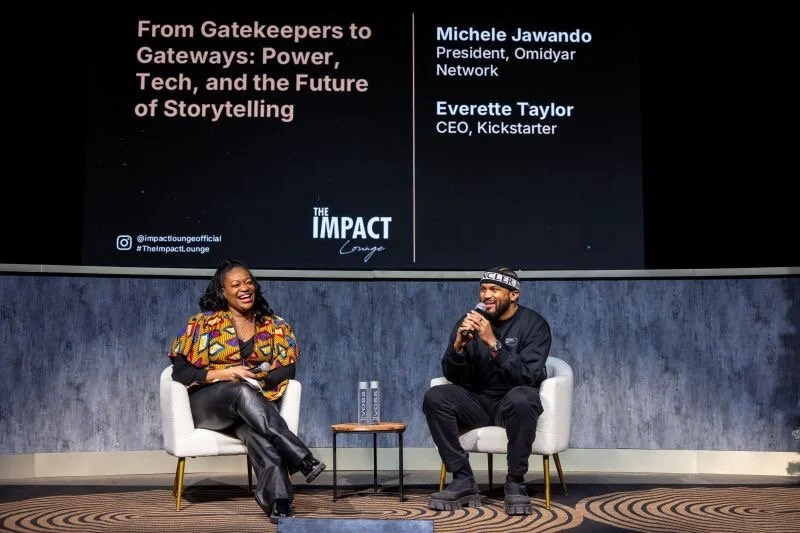
Michele Jawando, then President of Omidyar Network, speaks with Kickstarter CEO Everette Taylor at “From Gatekeepers to Gateways: Power, Tech, and the Future of Storytelling,” The Impact Lounge, Sundance Film Festival, Park City, Utah, Jan. 23, 2026.Less | Photo courtesy of The Impact Lounge
A data center goes up and the household power bill rises. An email app starts rewriting messages nobody asked it to touch. Headlines warn that jobs may disappear. For many Americans, that is what AI looks like, and Michele Jawando says it explains why so many are wary of it. “Most Americans are not anti-AI,” she says. “What they are concerned about is an AI future that doesn’t include them.”
Jawando is the CEO of Omidyar Network (ON), a philanthropy set up by eBay founder Pierre Omidyar and his wife, Pam. ON’s origin story, she says, is eBay itself, where “it was the first time two humans had to trust each other.” Today the organization spends its money on a bigger version of that question. Who gets to decide how artificial intelligence shapes ordinary lives? Jawando’s diagnosis is blunt. “AI doesn’t have a PR problem,” she says. “They have a design problem.”
Her view of design goes back to a living room in Queens, New York. Her father was a litigator, her mother a psychologist, and her grandparents, from Bermuda and Jamaica by way of London, stayed with the family throughout the year. Two shows could pull everyone around the TV. One was The Cosby Show. The other was Star Trek.
Star Trek was full of gadgets, and its crews used them to help alien civilizations. “It wasn’t about the tech itself,” Jawando says. “They were using it in service of something else.” And for a girl who loved science, writing and literature, the cast “looked like something I could be a part of.”
Years later, after a career in civil rights law and policy, with stints at tech companies including Google, she realized none of it was an accident. Creator Gene Roddenberry built it that way on purpose. “Intentional design changes everything,” she says. At ON, she wants to design “the spaces where decisions get made” so they hold “both alien and human ideas.”
Who gets invited
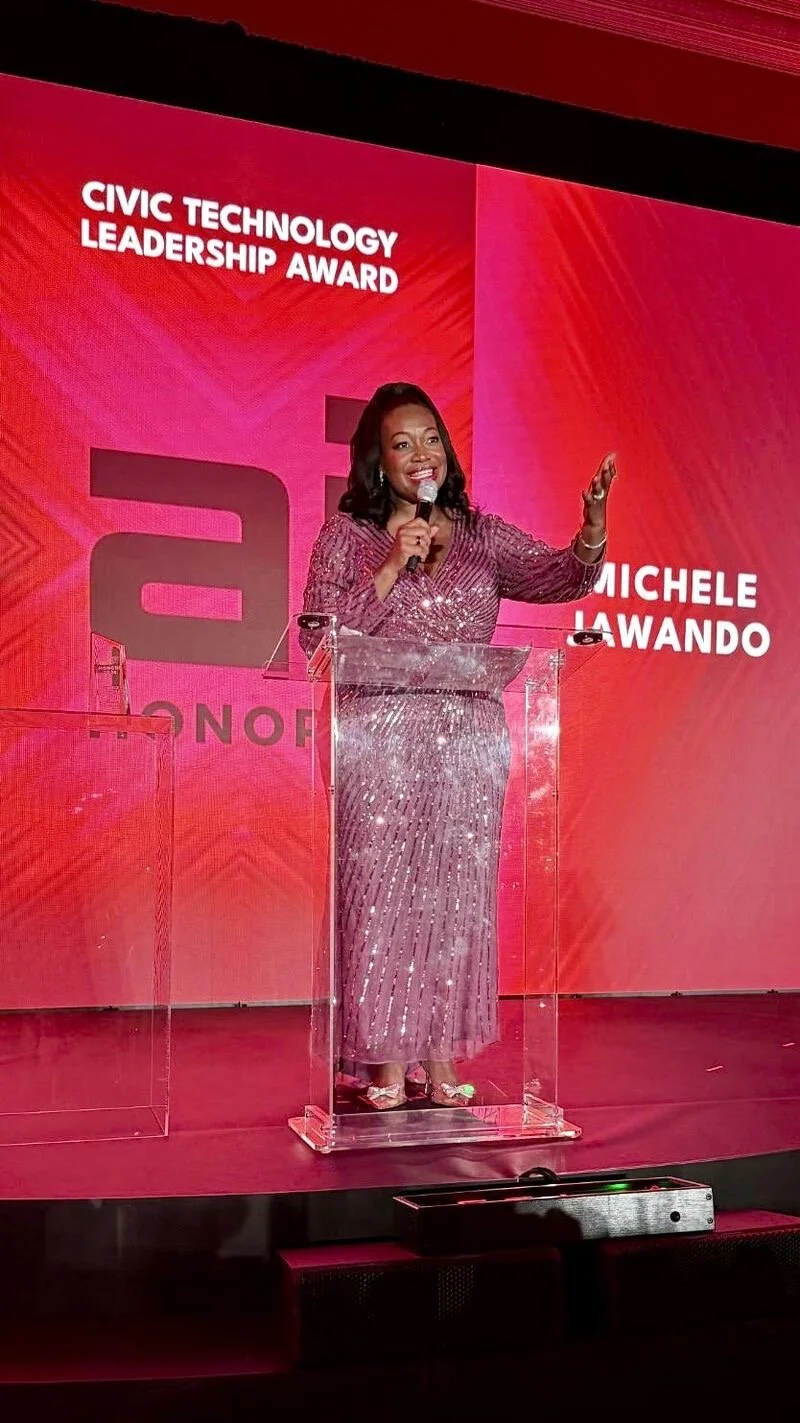
Michele Jawando accepts the Civic Technology Leadership Award at the Washington AI Network’s AI Honors Gala, Washington, D.C., June 3, 2026. | Omidyar Network
The leaders of the frontier AI labs, the companies building the most advanced systems, deserve a place at the table, Jawando says. “The problem is, by and large, they’re the only people we invite.”
The cause, in her view, is incentives. Many household-name tech companies started out meaning to use technology for good. Then the goal became maximizing shareholder value, and the products followed. “Most people don’t want an efficient life. Most people want a robust, full, loving, healthy life.”
So ON funds builders and critics alike. Jawando says it was an early investor in Anthropic because of the company’s focus on safety. It also backed researchers Timnit Gebru and Safiya Noble, who were warning about real-world harm “since day one,” long before AI safety became a mainstream conversation.
Wins that took years
Consider kids’ online safety, which ON funded for years with few visible results. The field was small, mostly scientists and academics. Then parents and students started telling their own stories. Families had been warning about harm to young people for years, Jawando says, long before any company acknowledged it. Platforms began competing to look responsible. “You create a race to the top,” she says. She points to California’s latest child safety policy covering AI companions, which she calls the first in the nation.
The Model Alliance, a New York nonprofit ON worked with, sponsored the state’s Fashion Workers Act, which requires a model’s written consent before an AI-generated version of their likeness is created or used. “If you’re a model, your face card is how you get paid,” Jawando says. The campaign put the human, not the software that could generate the image, at the center of the story.
Kinfolk Tech, a New York nonprofit, recently staged an installation called For Those Who Come After. Its founder, Idris Brewster, built it around a typewriter. Visitors asked a question, and it typed back a reflection drawn from James Baldwin’s archive. Jawando says the work was made with the Baldwin family. One visitor called it “actually cool AI.” That reaction is rare, she says, because most AI products aim at something duller. “People don’t get excited about their emails and someone helping them with an AI chatbot.”
Humanity AI grew from a problem Jawando spotted in her first foray into philanthropy. “Philanthropy has capital, but does not have collaboration.” The effort is a $500 million commitment from ten founding philanthropies to give civil society real power in shaping AI’s future. She co-chairs it with John Palfrey, president of the MacArthur Foundation. One project, AI civics, takes its cue from libraries. When Carnegie-funded libraries opened, anyone could take out a book for free because knowledge should be shared. Jawando wants AI treated the same way.
Losing a thousand times
Jawando thinks of herself as a Jedi Knight. In Star Wars, she notes, the Jedi lose again and again. Philanthropy works the same way, she says. “We are going to lose a thousand times, but every now and then we’re going to get that win, and that win is so significant.”
She has “never been more hopeful,” she says. Her evidence is that leading voices in AI recently admitted the industry can slow down and design differently, something researchers and advocates have said for years. If government doesn’t step up, people can still demand change, she says, and government often follows. “This moment is about design. It is not destiny. Nothing is inevitable.”
Her team is acting on that. ON’s narrative and culture team recently sent writers, artists and creatives from major TV shows and studios to the Joshua Tree desert for what it calls the AI Futures Base Camp. The assignment is to take the problems on the table and dream up new futures. Jawando wants stories with a different ending. “You can have stories where our future does not end with robots killing us,” she says. “Here’s a different version of this future.”
May the force be with her.
At Conspiracy of Love, we help changemakers tell their most powerful stories — stories that inspire action, build movements, and create lasting impact.
Find out more about our Values-Driven Storytelling and GPS to Purpose workshops, and how we can help you scale your impact.