How Good-Loop Has Turned Advertising Into A Force For Good
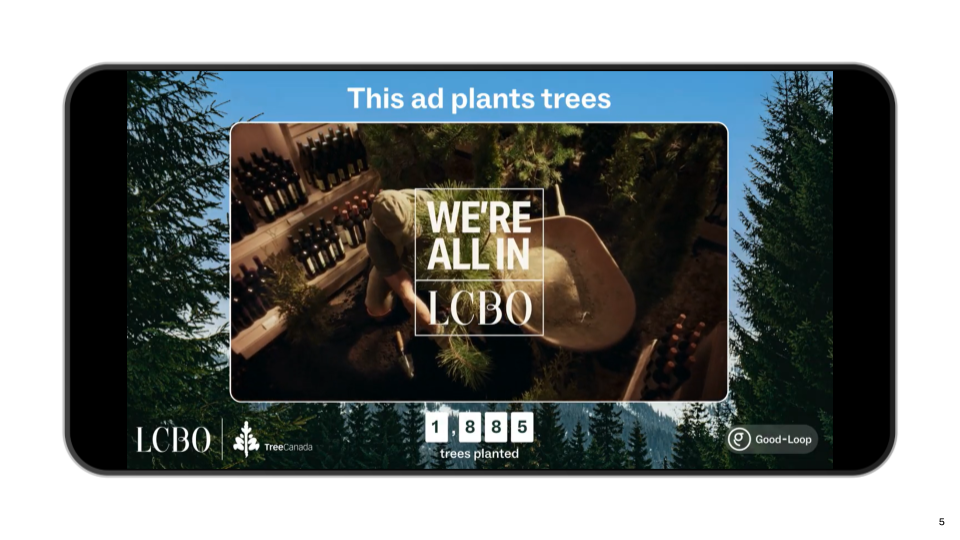
Good-Loop is an advertising platform that helps brands turn ad impressions into donations to nonprofits, while also helping improve media performance and reduce the carbon footprint of campaigns. | Good-Loop
There is a familiar choreography to digital advertising. A brand pays for attention. A consumer looks for the skip button. Everyone acts as if this is normal.
Amy Williams, founder and CEO of Good-Loop, built her company on a different idea. Good-Loop is an advertising platform that helps brands like Nike, Ford and Quaker Oats, turn ad impressions into donations to nonprofits, while also helping improve media performance and reduce the carbon footprint of campaigns. Advertising, she believes, can create a moment of genuine exchange instead of interruption.
"Good-Loop is fundamentally a value exchange," Williams said. "We create a moment of value exchange between an advertiser and a consumer." If the consumer chooses to give their time and attention, she said, "then in exchange, that advertiser will do good in the world."
Through its platform, ad impressions are converted into donations to nonprofits, with 20% of advertiser spend tied to attention-earned impressions. To date, Good-Loop has raised more than $14 million for causes ranging from Ronald McDonald Houses to turtle nest mapping and human rights campaigns. At the same time, it has helped brands improve the media metrics they care about most.
Amy Williams, Founder and CEO at Good-Loop | Good-Loop
Making ads worth watching
One of the smartest things about Good-Loop’s model is that it does not ask brands to choose between performance and purpose. It links the two.
Williams believes that is the only way responsible business strategies survive inside large organizations. "The way to make a responsible business strategy resilient within their organization is to tie it directly to business outcomes," she said. "How does social impact help you achieve your business objectives?"
In media, those objectives are clear. "It’s earn attention, drive engagement, and ultimately drive people to take an action," she said.
Good-Loop’s platform is built around solving two frustrations that define modern advertising. On YouTube, it is the skip button. On connected TV, it is the reflex of glancing down at a phone when the commercials begin.
Williams knows the impulse well. "I even work in advertising and I bloody love pressing that skip button," she said.
Good-Loop’s answer is direct. "We give people a genuinely good reason to give their attention and their time," she said.
That reason can change performance fast. For one yogurt brand running a back-to-school campaign on YouTube, completed view rates were sitting at 33%. Good-Loop partnered the campaign with Kaboom, the nonprofit that builds playgrounds across the United States, and told viewers that each completed view would help fund new play spaces. The completed view rate jumped to 78%, a 134% increase.
On connected TV, the same principle works differently. In a campaign for a vodka brand, Good-Loop used eye-tracking to measure whether viewers were actually looking at the screen. By making attention trigger a donation, the campaign generated 43% more eyes on screen.
Consumers are not as indifferent as the industry sometimes assumes. They may ignore bland, transactional advertising. But many will engage when a brand gives them a meaningful reason to.
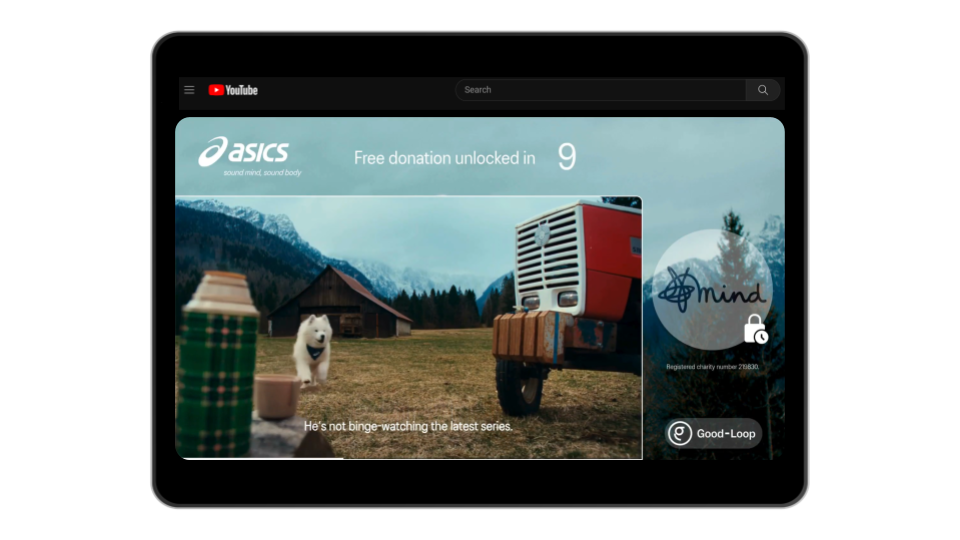
Asics Campaign | Good-Loop
Matching brands with causes that matter
Part of Good-Loop’s strength comes from how flexibly it can work across categories. The company has partnered with brands from Ford to Quaker Oats to Nike, and Williams said the common thread is relevance.
"Every business does good in some way," she said. "And perhaps more importantly, every consumer group cares deeply about something. We just have to find that right resonant issue and connect that brand with the right non-profit."
That might mean helping Ford connect its Bronco brand with conservation work through the Bronco Foundation. It might mean supporting Feeding America through Quaker Oats’ long-standing partnership. Or it might mean linking a wellness brand’s message to mental health charities.
That is one reason the model feels more durable than many purpose campaigns of the past decade. It is designed to create measurable value for everyone in the system. As Williams put it, the part she is most proud of is that the $14 million Good-Loop has raised came from "working media dollars" that also helped brands improve performance.
Cutting the carbon cost of media
About four years ago, the company began asking a question much of the industry had ignored. What is the carbon footprint of advertising itself?
"Turns out no one was really asking that question," Williams said.
In partnership with Ad Net Zero, Good-Loop developed one of the first platforms to measure and help advertisers reduce emissions from the media they buy, across digital and offline channels. The system tracks factors inside the ad supply chain that affect computational power and emissions, including creative asset weight, supply-chain complexity and whether an ad is served over Wi-Fi or mobile data.
Good-Loop has measured more than 76 billion ad impressions, which together generated 118 million kilograms of CO2 equivalent.
But the platform does not stop at measurement. It identifies practical opportunities for reduction. Heavy files can be flagged and optimized. Carbon-intensive sites can be identified and removed from media buys. Those changes, Williams said, can reduce emissions by 25% to 75%.
For brands struggling to make progress on Scope 3 emissions, that is not trivial. It is a reminder that sustainability is often less about grand gestures than about redesigning the hidden systems most people never see.
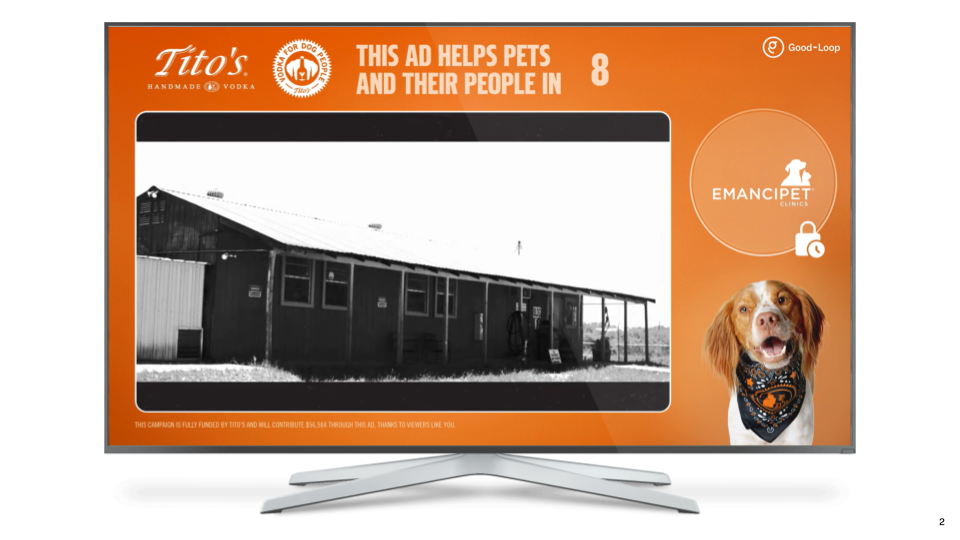
Tito's campaign | Good-Loop
Building a business that can last
Williams has also been intentional about the kind of company Good-Loop would become internally. Good-Loop became a certified B Corp in 2018 and has since recertified twice, improving its score each time even as the business scaled.
"Being a B Corp has been foundational to how I’ve grown my business," she said. "It’s helped me establish a framework for responsible decision making."
That framework has shaped more than governance. It has helped attract talent too. Williams said multiple employees told her they applied because of Good-Loop’s B Corp certification. "Whenever anyone tells you that B Corp doesn’t have ROI, it’s just so far from my own lived experience," she said. "It attracts talent. It helps you grow in a sustainable and thoughtful way. And it connects you with a community that in tougher moments is incredibly inspiring."
Those tougher moments have arrived. Over the last few years, many companies have quietly softened commitments around DEI, climate and responsible business as political and cultural headwinds have shifted.
But Williams also sees a harder, more useful lesson in the moment. "What it has given us is an opportunity to rebuild some of these ideas in a more resilient and integrated way," she said.
That may be the real story of Good-Loop. Not simply that it helps brands do good. But that it has learned how to prove that doing good can create business value too.
"We are creating, measuring, and quantifying the business value that is created," Williams said. "That exercise has really helped us to build a business that is resilient, even at times when it’s perhaps less trendy to do good just for the sake of it."
Good-Loop is not betting on goodness as a passing mood. It is building it into the mechanics of how modern advertising works. And in doing so, tranforming the ability for brands to do well by doing good.
At Conspiracy of Love, we help changemakers tell their most powerful stories — stories that inspire action, build movements, and create lasting impact.
Find out more about our Values-Driven Storytelling and GPS to Purpose workshops, and how we can help you scale your impact.