Bottom Line And Get Schooled Join Forces To Bring College Guidance To More Students

(c) della chen photography
When it comes to higher education, most young people don’t lack ambition. They lack a guide to what is a very complex and confusing topic.
In many communities, the support simply isn’t there in the numbers students need. Get Schooled Executive Director John Branam points to a stark reality. The national high school, college, and career counselor to student ratio is “about 1 to 385.”
That reality is the backdrop for a newly announced merger between Bottom Line and Get Schooled, two leading nonprofits that have been tackling the college access challenge from different angles. Bottom Line, headquartered in Boston, is known for high-touch, one-on-one advising that has been rigorously evaluated for impact. Get Schooled, with roots in Seattle and a national digital footprint, has built tech-enabled guidance and resources designed to reach young people where they already are.
Together, they’re trying to answer a practical question with big consequences. How do you scale support without losing the human trust that makes it work?
From parallel paths to one shared model
Colón says Bottom Line spent years optimizing for depth. “We wanted to have the deepest impact with students, and often that meant that we were trading off scale,” he said.
Over time, that tradeoff started to feel less like a strategy and more like a constraint. Colón describes the question that drove the next step. “How do we intertwine both impact and scale together to be able to serve lots more students and be able to create a whole lot more good?” he said.
He had known Branam and Get Schooled’s work for years. What felt compelling was the complementarity. “They were already a scaled player. We were already an impact player,” Colón said.
Branam tells a parallel story. Get Schooled had expanded broadly, but he believed the next phase required a partner with deeper strengths across the pipeline. “We had gotten to the point where we felt like we had more or less scaled as much as was possible,” he said. “We needed a partner whose areas of strengths were complementary to ours.”
The spark wasn’t a boardroom moment. Branam recalls “coffee over breakfast one morning in DC,” when the conversation shifted. “We both walked away saying, there’s something a little more interesting here,” he said.
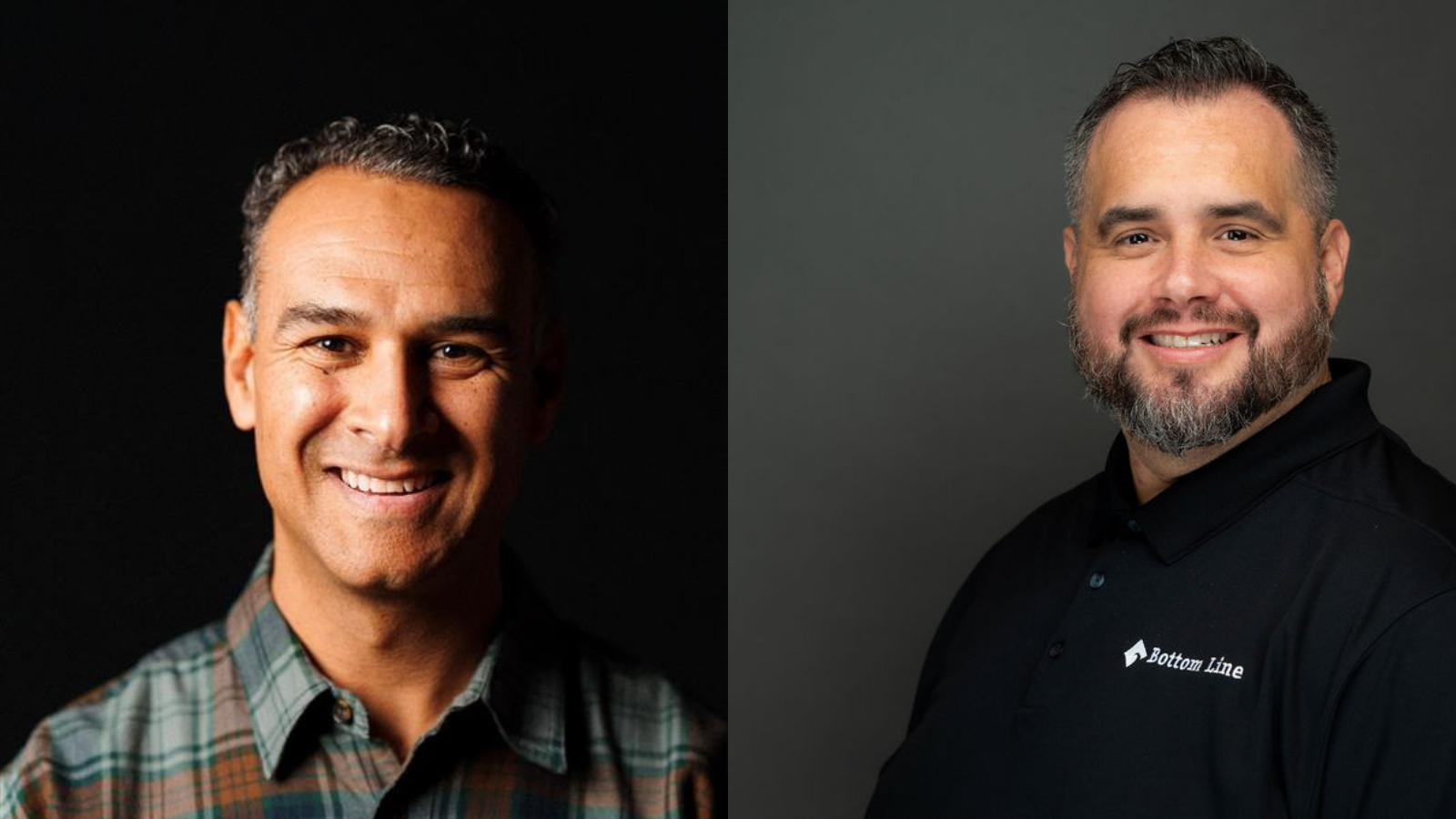
From left to right: John Branam, Executive Director, Get Schooled; Steve Colón, CEO, Bottom Line | Bottom Line, Get Schooled
What stays and what changes
The merged organization will keep Bottom Line as the parent name, while Get Schooled remains as the tech-driven program supporting large numbers of students. Steve Colón will remain CEO, and Branam will become Chief Transformation Officer.
Colón says the naming choice was about protecting trust that already exists on both sides. “We’re going to keep Bottom Line as the name of the parent organization,” he said, “and we are going to also keep Get Schooled as a name of the personalized tech-driven program.”
Get Schooled’s brand, he notes, is already strong with students nationwide, while Bottom Line is closely associated with impact among funders and partners. “We wanted to be able to trade on the brand equity of both organizations for as long as we could,” Colón said.
The case for college without pretending it is simple
The merger comes at a moment when the value of college is being debated louder than ever. Colón doesn’t deny the anxieties about cost and debt. But he argues the research still points in one direction. “The evidence and the research is still really clear,” he said, “that a bachelor’s degree provides a disproportionate amount of support to students on their lifelong career.”
Where the conversation goes wrong, he believes, is when people treat higher education as one uniform product. “They tend to think of college as a few select institutions that have ivory walls and that cost a ridiculous amount of money,” Colón said.
In his view, the right question isn’t whether college is automatically good or bad. It’s whether students have the information and support to choose a pathway with a positive return. “What they need is knowledgeable partners that can help them make choices to ensure that they get a positive return on investment,” he said. “It’s really about creating savvy consumers of higher ed.”
That philosophy applies across postsecondary options. Colón emphasizes helping students understand not only what a program costs, but what it can unlock over time. “There’s a variety of post-secondary options available to students,” he said, and the point is to make decisions “based on the information that’s available to you” about earnings, debt, and long-term value.
Bottom Line
Human connection scaled responsibly
Branam is explicit that technology is the delivery system, not the relationship. “In the new Bottom Line, we continue to place at the heart of our work human beings,” he said.
He describes a model where advisors shape the guidance students receive, and technology enables speed. People oversee the flow, learn from what students ask next, and step in when a situation requires a more personal response. “It really is about a partnership between real human beings and technology,” Branam said. “It’s not a case where the technology has taken the place of human beings.”
Colón puts it plainly. “Humans do what humans are great at, but machines do what machines are great at,” he said. “Let them combine to be powerful.”
Proof, reach, and what success will mean now
Bottom Line enters the merger with an uncommon form of credibility in the space, rigorous evidence of outcomes. A randomized controlled trial found Bottom Line participants are 13% more likely to enroll in a four-year college, 28% more likely to enroll in a high graduation rate college, and 23% more likely to earn a bachelor’s degree within four years.
Branam calls that proof a foundation the merged organization intends to keep. “It’s the only organization in our collective space that can say, with absolute confidence, by economists, that it actually nails the impact it says it wants to achieve,” he said.
Get Schooled brings scale and engagement. The organization reports more than 116 million views across its channels and partner channels during the 2024 to 25 school year, serving youth ages 16 to 21, with 88% from historically underserved populations. In a student survey of 1,300 participants, 90% said they would recommend Get Schooled to a friend.
Branam says the next chapter is combining these strengths without losing either. “We’re really excited in the next months and years ahead to figure out what’s the marrying of those two kinds of impact data,” he said.
A merger meant to model what is possible
Mergers are rare in education nonprofits, and often happen out of distress. Branam is clear this one is rooted in opportunity. “Mergers do not happen in our space very often,” he said, particularly mergers designed to “achieve new heights” rather than serve as “a lifeline.”
For Colón and Branam, the point is not consolidation for its own sake. It’s whether more students can make smarter decisions earlier, with someone in their corner, and with the kind of support system that can actually keep up.
At Conspiracy of Love, we help changemakers tell their most powerful stories — stories that inspire action, build movements, and create lasting impact.
Find out more about our Values-Driven Storytelling and GPS to Purpose workshops, and how we can help you scale your impact.