Why Benevity Believes Corporate Volunteering Needs Re-Imagining
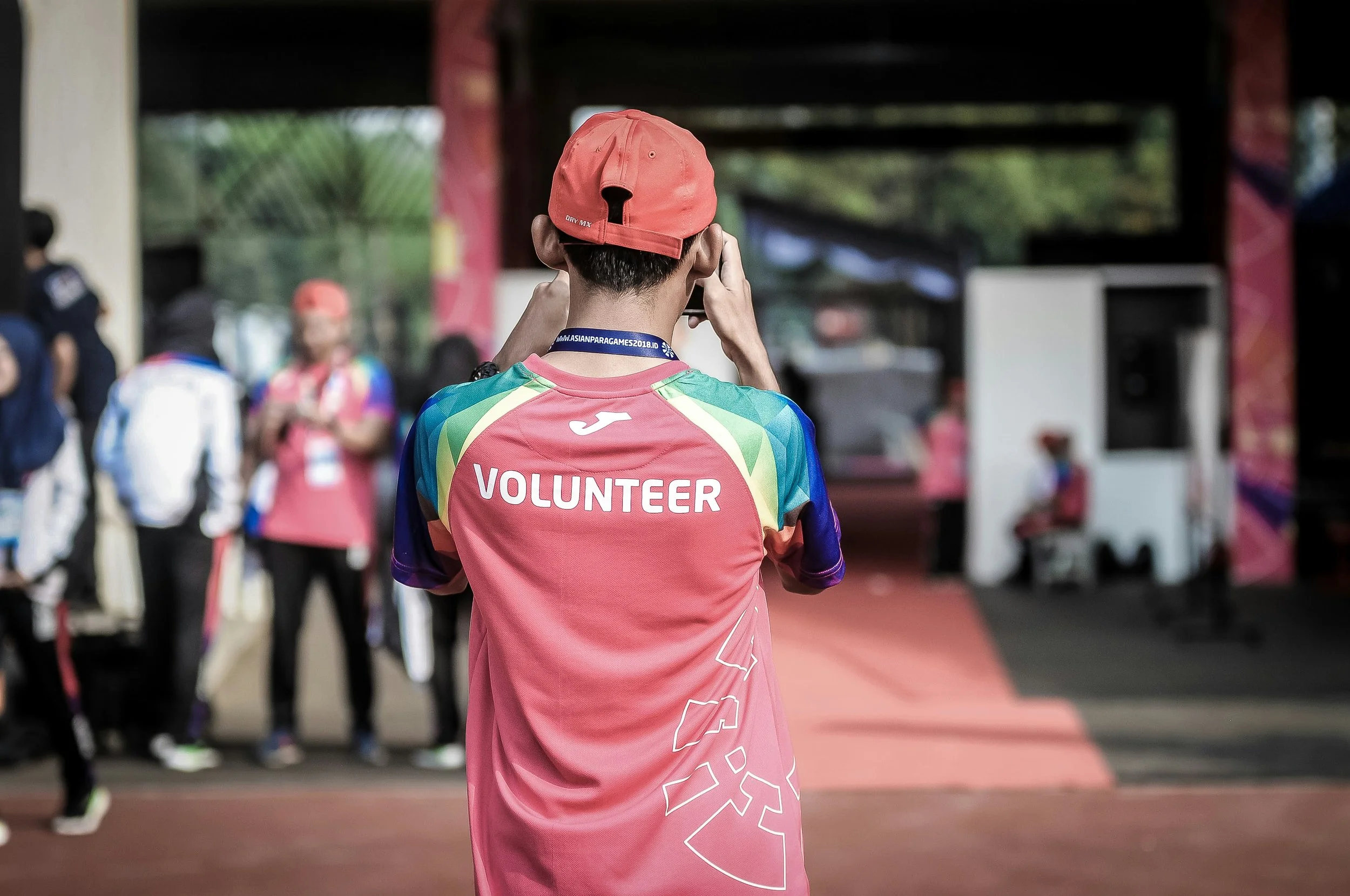
Nearly 1,000 enterprise companies trust Benevity to help them lead with purpose, inspire action, and create measurable social and business impact on a global scale. | Credit: Ray Sangga Kusuma , Unsplash
For years, corporate volunteering was often framed as a feel-good benefit. It helped attract talent, gave employees a chance to support causes they cared about, and signaled that a company stood for something beyond quarterly results.
That framing was not wrong. It helped open the door to a more human, more participatory approach to corporate purpose. It brought more people in, made purpose feel more personal, and gave companies a way to connect business with something bigger than the bottom line.
But as Sona Khosla sees it, the opportunity has now grown far beyond that.
Khosla, Benevity’s Chief Impact Officer and the leader behind Benevity Impact Labs, has spent nearly 11 years watching this space evolve from the inside. She joined the company to lead marketing, then later made what she described as a major career pivot into impact work, helping build Benevity’s social innovation lab to turn data into clearer guidance for companies trying to make their purpose programs more effective.
That perspective shapes Benevity’s latest report, The State of Corporate Volunteering 2026, subtitled A System Ripe for Reimagining. And while the report highlights some real tensions, its larger message is an optimistic one. People still want to show up. They still want to contribute. The challenge is not how to spark interest, but how to help that interest grow into something deeper and more strategic.
Sona Khosla, Chief Impact Officer | Benevity
A decade of change
When Khosla first arrived at Benevity, the idea that companies would actively support employees in backing the causes they cared about still felt relatively new. Many businesses were moving away from a top-down model, where leadership chose the issues, and toward one that gave employees more choice through matching, volunteering and other purpose programs.
At the time, that shift felt significant. In a competitive talent market, especially in tech, companies began to see purpose as a differentiator. Benevity was part of that change, helping organizations build digital platforms that made giving and volunteering easier across markets, office settings and deskless workforces.
Then the context changed - and kept changing.
The pandemic raised expectations for how companies should respond in moments of crisis. The murder of George Floyd pushed many organizations to invest more directly in racial equity and justice. Then the anti-DEI/ESG backlash turned many of those same issues into political flashpoints. At the same time, remote work, hybrid work, return-to-office pressures, economic uncertainty and AI all reshaped how employees experienced work itself.
“The last five years have been a fascinating moment where you’ve had deep investment, pendulum swinging all the way one way, fear, risk, reputational concerns and harm. Pendulum swings the other way,” said Khosla.
For Khosla, that whiplash made it clear that companies needed more than good intentions. They needed better insight into what was actually working.
What the data gets right
The headline numbers are striking. Corporate volunteers logged 23.7 million approved hours in 2025, a 175% increase from before the pandemic. The number of unique volunteers more than tripled to 1.87 million. Participation rates rose by 30%.
“There’s a lot to celebrate on the surface of things. It’s like, wow, there are a lot more people getting involved.”
That matters. At a time when employees are stretched and under pressure, the fact that so many people still want to give their time says something important.
But the report also surfaced a more complicated trend. Average hours per volunteer fell from 16.5 to 12.7. And a new group Benevity calls the micro-volunteer now makes up 60% of all volunteers, with each contributing fewer than five hours a year.
Khosla does not interpret that as a sign that volunteering is fading. She sees it as evidence that companies have become very good at getting people in the door.
“We’ve been tremendously successful at recruiting new people into this action. What we haven’t done as great of a job is really nurturing people into deeper paths of engagement over time.”
This is not simply a picture of decline. It is a picture of growth that has outpaced design. Companies have responded to the realities employees face by creating shorter, more flexible opportunities. In many ways, those programs have worked. More people are participating. The next step is to help them stay engaged.
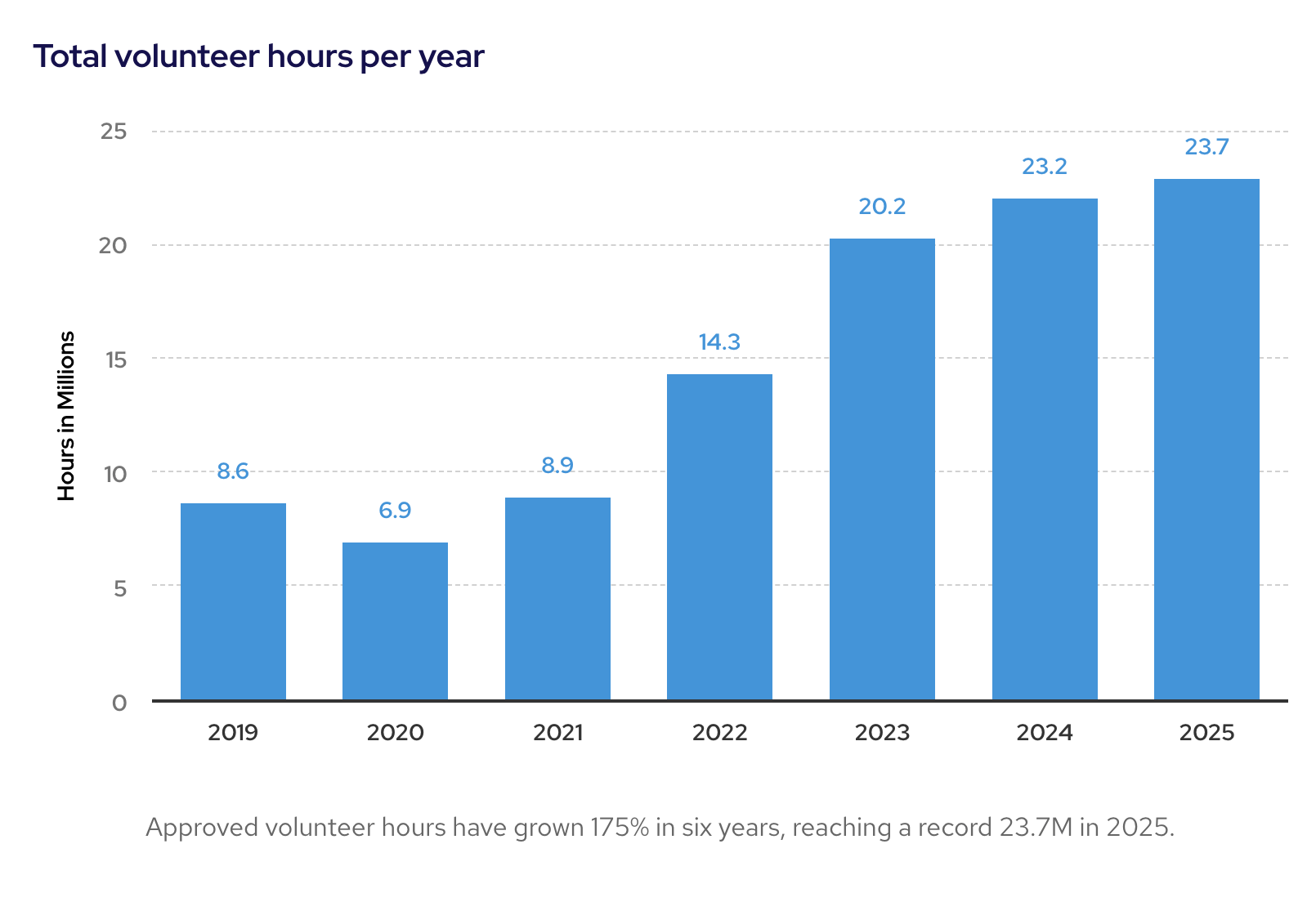
Approved volunteer hours have grown 175% in six years, reaching a record 23.7M in 2025. | The State of Corporate Volunteering 2026 Report, Benevity
From time off to time invested
Employees are dealing with job uncertainty, financial strain and new questions about what success looks like in an AI-driven workplace. Managers, under pressure themselves, may be less likely to encourage time away from core responsibilities.
That is why Khosla believes the language around volunteering needs to change.
Too often, companies still talk about ‘volunteer time off’, as though it sits outside the real work of the business. She argues that this framing misses the larger value volunteering can create.
“It’s volunteer time invested. It’s actually skills development time.”
That shift opens up a stronger case for why volunteering matters now. Khosla points to the human capabilities it helps build, including empathy, active listening, teamwork, problem-solving and adaptability. Those are exactly the kinds of skills that will matter more as AI takes on more analytical and repetitive work.
“Volunteering should be considered part of the core infrastructure of the future of work.”
Volunteering, done well, can help employees grow while also creating real value for communities.
A better match between business and nonprofit needs
The report also points to a gap companies need to take seriously. Many businesses are increasing budgets for team-based and skills-based volunteering, while nonprofits are facing a funding crisis and often need financial support more urgently. Khosla noted that only 20% of nonprofits say corporate volunteers contribute meaningfully to their long-term capacity.
That does not weaken the case for volunteering. It strengthens the case for designing it better and measuring it more thoughtfully.
Right now, many companies still focus on participation, total hours and total volunteers. Those numbers matter, but Khosla argues they are only the starting point. The more useful question is what outcomes volunteering is meant to drive, whether that is building unity after an acquisition, strengthening cross-functional relationships or helping address social issues tied to business risk.
“The onus is on leadership to take a step back and say exactly what we are volunteering for in the future.”
The bigger opportunity ahead
Khosla also pointed to the wider global context. At the Second World Summit for Social Development in Doha, held in November 2025, the UN adopted the Doha Political Declaration, reinforcing the urgency of social cohesion and inclusion as global priorities.
For her, that only strengthens the case for treating corporate volunteering more seriously — not as a side program, but as something that can help companies develop people, support communities more meaningfully, and respond to a more fragmented world with greater intention.
At Conspiracy of Love, we help changemakers tell their most powerful stories — stories that inspire action, build movements, and create lasting impact.
Find out more about our Values-Driven Storytelling and GPS to Purpose workshops, and how we can help you scale your impact.