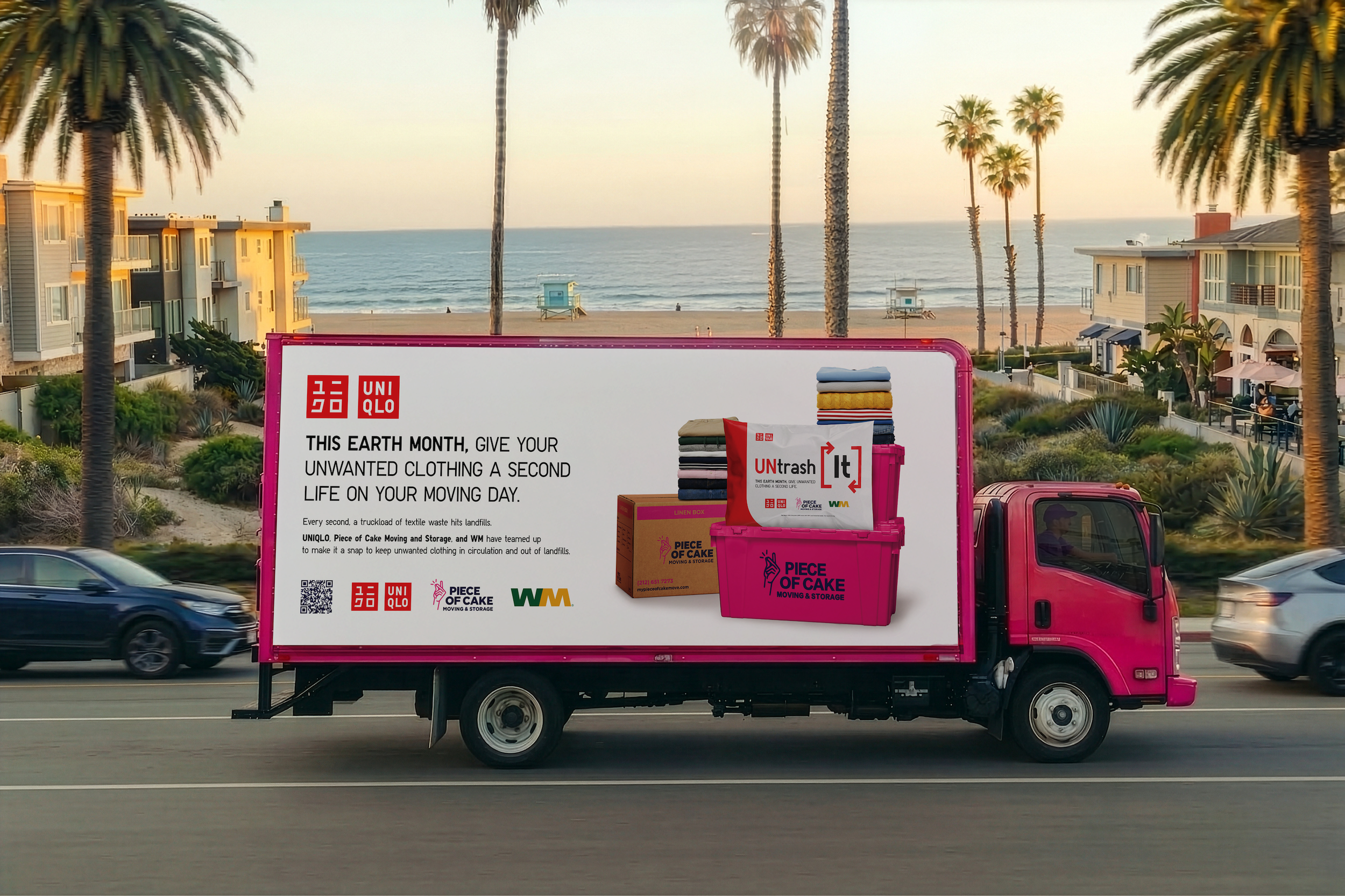
UNTRASH IT - Give your unwanted clothing a second life on your moving day | UNTRASH IT
Every year, as spring arrives and leases expire across America's cities, millions of people face the same moment of reckoning — surrounded by overstuffed closets, confronted by clothes they haven't worn in years.
It's a small, private drama that plays out in apartments from Manhattan to Dallas to Los Angeles. And it has been, for decades, a story with only one ending: the bag gets tied, the clothes get tossed, and another contribution gets made to the 85% of discarded textiles that end up in landfills or waste-to-energy facilities.
Not because people don't care. Because nobody made it easy enough to do anything else.
That’s the gap that Uniqlo, WM and Piece of Cake decided to fill together. I caught up with Jean Emmanuel Shein, Sustainability Director at Uniqlo USA, Najah Ayoub, CMO of Piece of Cake Moving and Storage, and Raymond Randall, who leads WM’s Textile Recycling Initiatives to learn more about the program their companies collaborate on - as elegant as it is overdue.
The Moment Nobody Thought To Ask About
The initiative is called UNTRASH IT. Anyone moving with Piece of Cake during April receives a notification two days before their move — movers will have Uniqlo bags on the truck. Opt in, fill the bags with unwanted clothing, hand them over. That's it.
By the end of the month, Piece of Cake consolidates everything at its storage facilities and delivers it to Uniqlo, where the team sorts between wearable and unwearable. Wearable items go to Uniqlo's network of nonprofit partners, including the New York Department of Homeless Services and Covenant House. The unwearables are then sent to WM's facility in Greenville, South Carolina — the first of its kind in the United States, equipped with robotics and near-infrared scanners — where they're broken down by fiber type for recycling or upcycling.
In its first year, limited to New York City, somewhere between 30 and 40 percent of Piece of Cake's April customers opted in. This year, the program has expanded to Dallas and Los Angeles.
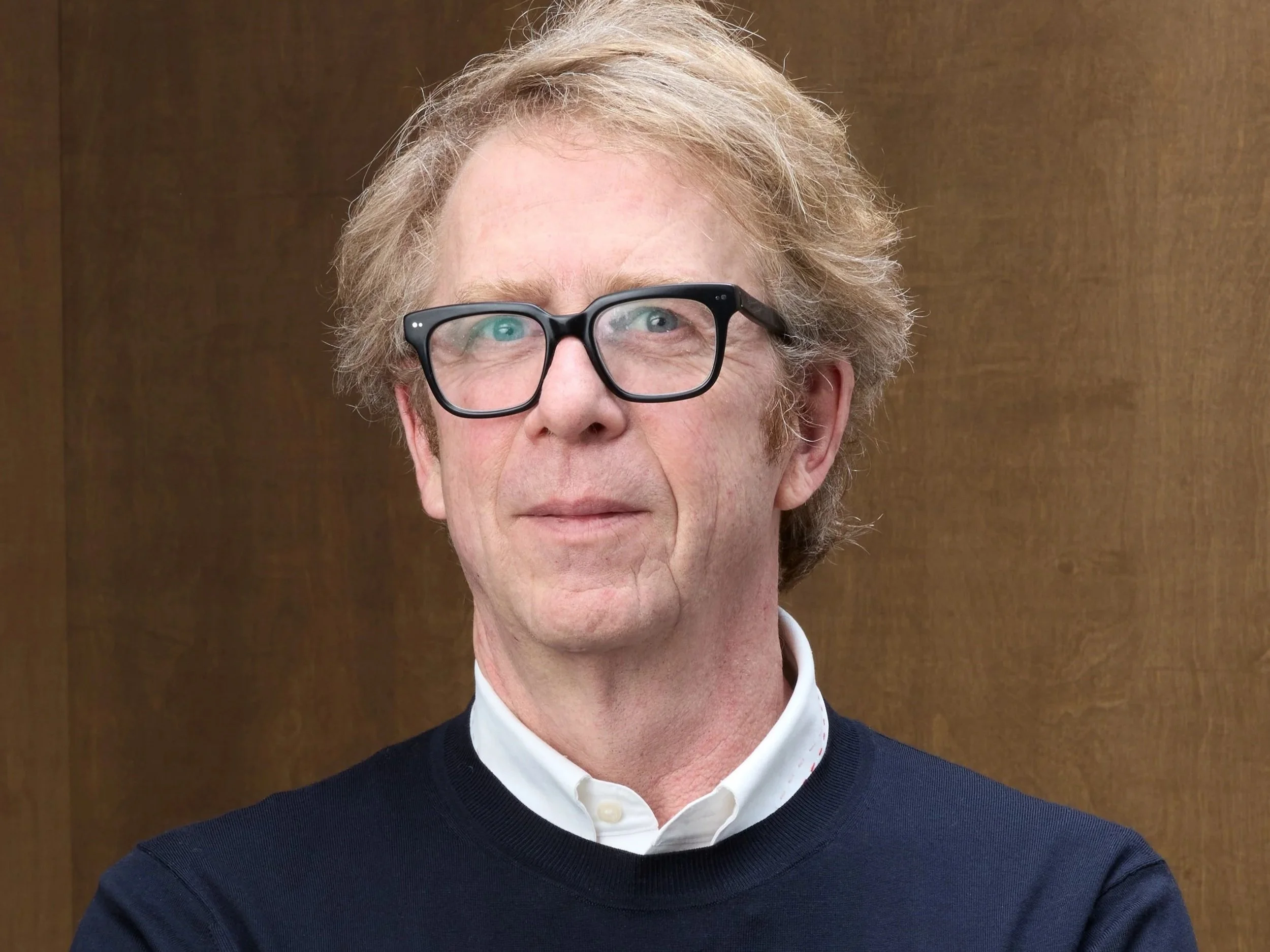
Jean Emmanuel Shein, Sustainability Director at Uniqlo USA | Uniqlo US
The Thirty-Foot Theory
The insight driving all of it isn't complicated. It's just honest. "There's always a correlation between convenience and participation," Randall says. "When we make it more convenient for consumers to do something better with their materials, they will." WM has watched this dynamic play out across every recycling program it has ever run. Remove the inconvenience, and people show up. Leave it in place, and they don't — not because they're indifferent, but because life is busy and the bar is set too high.
Ayoub saw the same thing from a different angle. Piece of Cake's customers routinely asked before their moves whether the company handled furniture disposal. Nobody asked about clothing — but that didn't mean the problem wasn't there. "In the city, it's really difficult" to find clothing recycling options, she says. Moving day, she recognized, is a rare moment when people are already in the mindset of editing their lives. "It's a great moment where people can take a stock take on their lives." Making it convenient to act on that instinct — right then, in that moment — is what Untrash It actually does.
For Uniqlo, the program sits inside a much larger global architecture. Across 2,500 stores worldwide, collection boxes accept donations from any brand year-round. Wearable items are redistributed to local partnersthroughout the United States, such as homeless services organizations, and globally partners with UNHCR to support displaced people around the world. "This is a very important program that we're very proud of indeed," Shein says. Untrash It is an extension of that commitment, designed specifically for the moment when people are most ready to let things go.
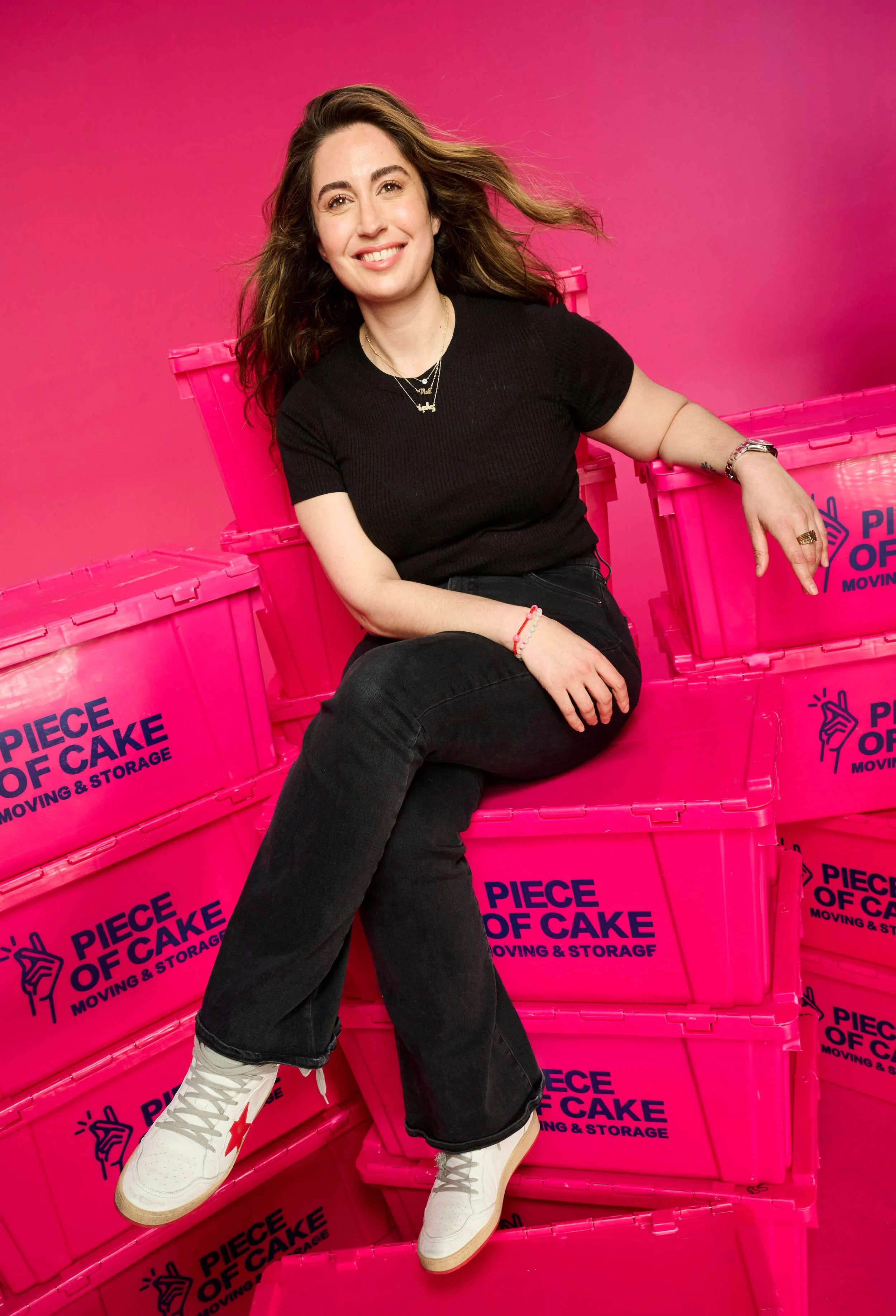
Najah Ayoub, CMO of Piece of Cake Moving and Storage| Piece of Cake and Storage
A Facility Unlike Any Other
The urgency underneath all of this is real. The EPA has tracked textile waste trends since 1980, and the lines have barely moved. "If we do more of the same, we're going to get more of the same," Randall says flatly.
WM recovered 16 million tons of recyclables in 2024. Its target is 25 million tons by 2030, and textiles are a significant part of how it gets there. The Greenville facility is the infrastructure bet behind that ambition — a place where unwearable clothing can be sorted by fiber composition and fed into an emerging fiber-to-fiber recycling market, where the cotton in a discarded shirt eventually becomes the cotton in a new one. So far, the facility has not exported or landfilled a single item. "Those seem to be the bookends people are concerned about," Randall says, "given the volume of material going to landfill."
The supply chain for a genuinely circular textile economy is assembling itself. What it has always lacked is a reliable front end — convenient, high-volume collection that meets people where they already are.
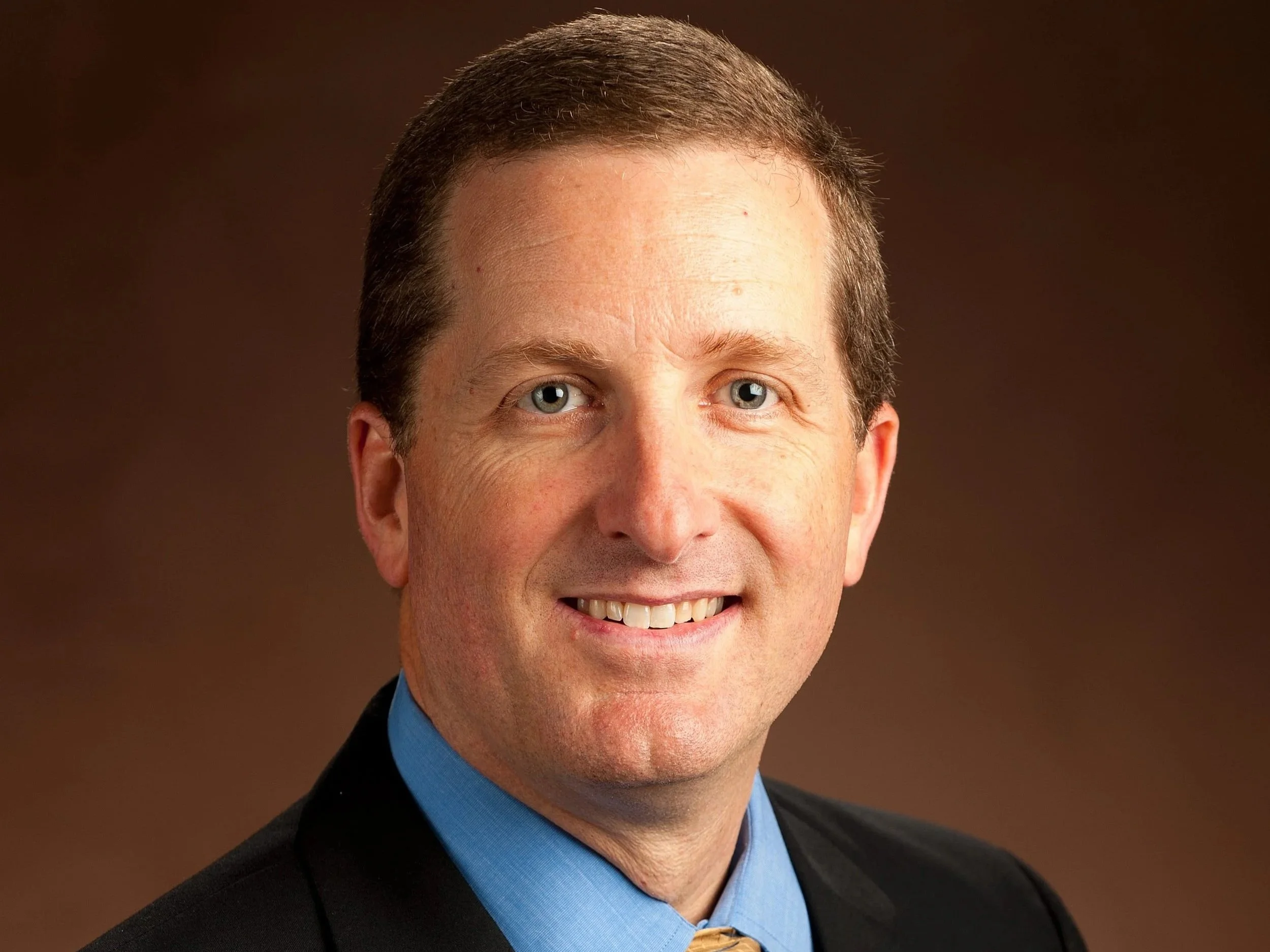
Raymond Randall, who leads WM's Textile Recycling Initiatives | © Woodallen Houston
The Thing None Of Them Could Build Alone
Piece of Cake is not a sustainability company. Uniqlo is not a logistics company. WM is not a fashion retailer. And yet the thing they've built together is something none of them could have built alone — which is, in some ways, the whole point.
Ayoub is candid about what this should mean for other brands that assume scale requires size. "A lot of brands think they can't do big things," she says. "There is opportunity for brands to collaborate and do very interesting things, whether that be in sustainability or in general."
Shein frames it slightly differently, pointing to something harder to measure but equally important. Beyond the bags filled and fibers sorted, there is the act of making this visible — putting a name on the problem, giving customers a way in, letting the story travel. "It raises awareness of this issue more than ever," he says, "especially amongst younger people." Not everyone opts in. But everyone, now, has been asked.
That question — asked across hundreds of thousands of moves, in three cities, during the one month when people are most primed to hear it — is its own form of infrastructure. Moving day has always marked a fresh start. Three unlikely partners have decided it can also be the moment we finally start dealing with what we've been leaving behind.
At Conspiracy of Love, we help changemakers tell their most powerful stories — stories that inspire action, build movements, and create lasting impact.
Find out more about our Values-Driven Storytelling and GPS to Purpose workshops, and how we can help you scale your impact.