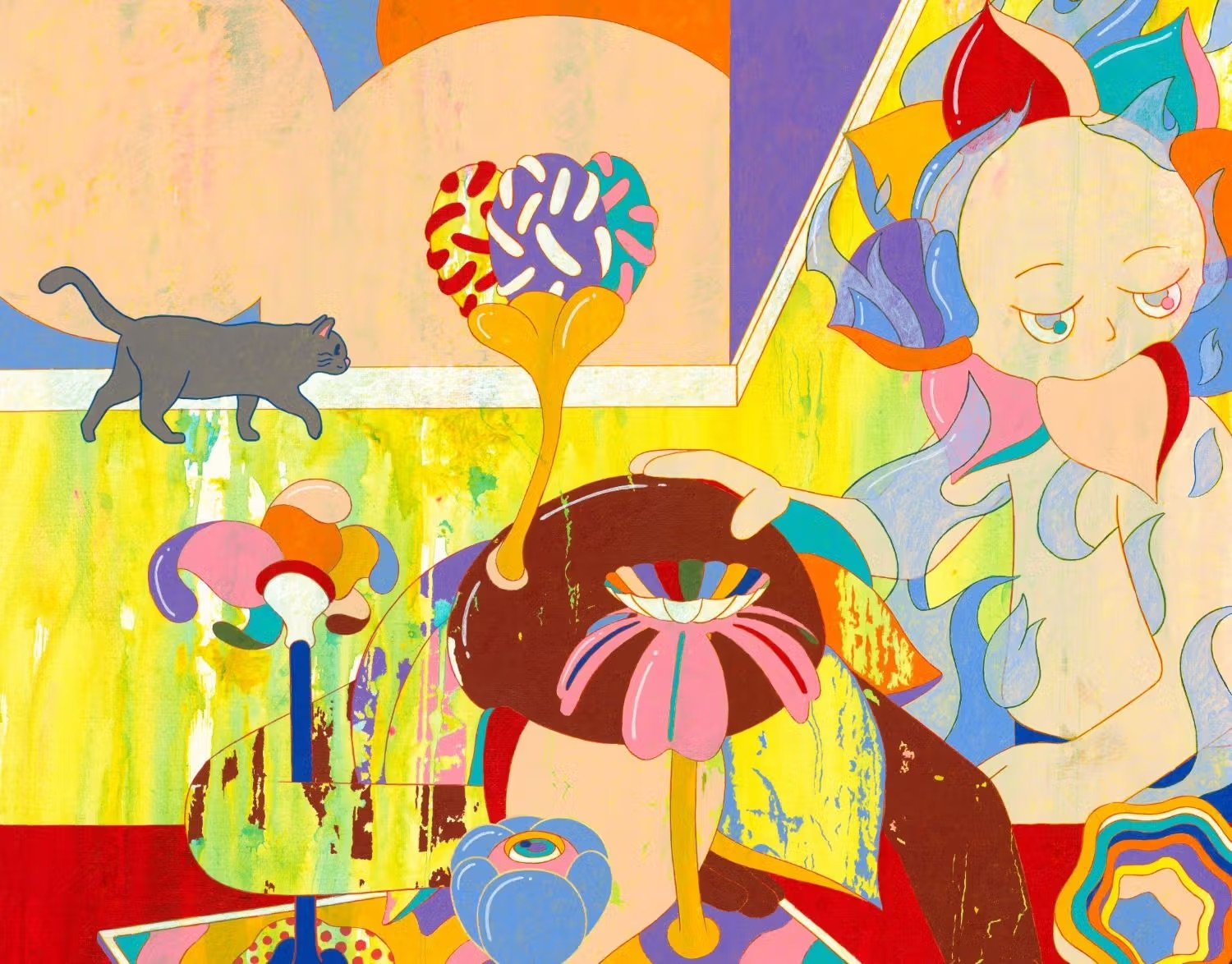
No Other Choice (2026) | © MURUGIAH
Every Christmas, Battersea Power Station becomes a canvas. The tradition has drawn David Hockney. It has drawn Wallace and Gromit. In 2024, Apple added a new name to that list: a British-Sri Lankan illustrator from Wales, whose strange, tubular-limbed characters with anime eyes and inexplicably large boots lit up one of London’s most iconic facades for thousands of people who had never heard of him.
"Seeing those trees projected on the side of Battersea Power Station was quite a thing," Sharmelan Murugiah says. "Pretty exciting." Now, something bigger is coming. This Friday, the Quentin Blake Centre for Illustration opens in London withMURUGIAH: Ever Feel Like… as its inaugural solo exhibition, running through August 31st — and the choice of Murugiah to launch the Centre's first major show is not incidental. It is, in itself, an argument about whose imagination deserves a stage.
The Artist the Algorithm Can't Place
The Centre, founded by the legendary children’s book illustrator Quentin Blake, is the UK's first institution dedicated entirely to illustration. Its mission is to challenge a long-standing hierarchy: to argue that the image made to accompany a story, a poster, or a record sleeve can carry as much emotional truth as anything hanging in a white-walled gallery.
Murugiah's work makes that argument viscerally. His paintings don't depict reality; they excavate feeling. Brightly colored, surrealist, and deliberately disorienting, they sit at the intersection of identity, mental health, and cultural displacement — the things people carry privately and rarely see reflected back at them. Murugiah renders all of it in fluorescent, unsettling, and oddly cathartic detail.
"Thematically, it is very much about core inner feelings," he says. "By representing those feelings in this very brightly colored surreal way, I'm juxtaposing two different methodologies. A very core, deep emotional feeling presented in a surreal way." That tension — between the weight of what's inside and the wildness of how it looks on the outside — is not a stylistic quirk. It is the whole point. And it took years to arrive at honestly.
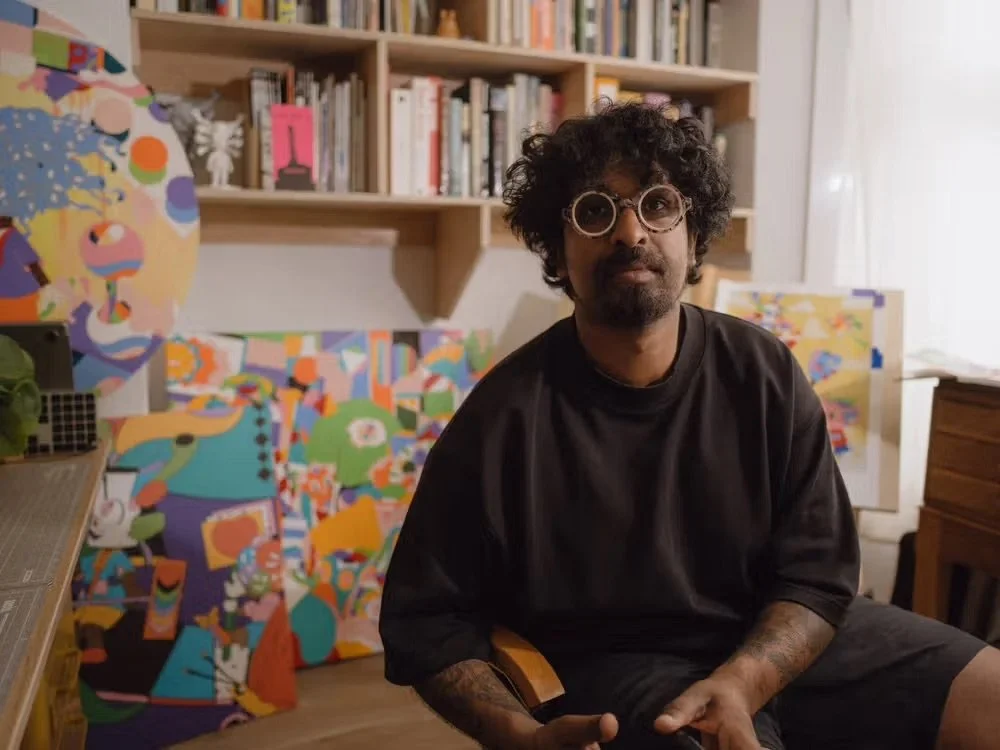
Sharmelan Murugiah | Quentin Blake Centre for Illustration
The Culture He Almost Left Behind
Murugiah was born and raised in Britain to parents (Mrs Rahiny Murugiah and Dr Subramaniam Murugiah) who emigrated from Sri Lanka in the late 1970s and early '80s. Pop-punk soundtracks, Disney animations, Hollywood blockbusters, sci-fi and horror — all of it poured into his imagination and stayed. For a long time, that Western inheritance was the whole story he told about himself. The other half — the Sri Lankan culture that lived in his parents’ home, in their ornaments, their religious artwork, their sense of the world — sat at a distance.
"I’m a person of two worlds," he says, "yet I have spent most of my life wanting to assimilate into Western culture. Like many people my age, I am recognizing that I have this entire culture that belongs to my parents that I have the comfort of exploring now. I didn’t before, and I do now." That reckoning — with heritage, with belonging, with the quiet weight of feeling like you exist between worlds rather than fully inside one — is what gives the exhibition its emotional core. These are not abstract themes. They are the specific texture of a life, rendered visible.
The shift is now unmistakable in the work. A recent gig poster for the psychedelic rock band Phish places his signature three-headed Maru character atop a lotus flower — a direct nod to the ornamental Sri Lankan religious artwork he grew up seeing in his parents' home. At the base of the poster sits Anish Kapoor's Cloud Gate, the giant reflective sculpture in Chicago's Millennium Park, anchoring the image to the city where the band was playing. Sri Lankan iconography, American public art, and British illustration sensibility in a single image. Not a collision — a synthesis. "I was really able to be more of myself," he says. "Now whenever a gig poster comes in, I will make sure that it's me that's being put forward."
Going Fully Alternative
The commercial work kept coming. Gig posters for Elton John and Foo Fighters. Alternative film posters for Everything Everywhere All at Once and RoboCop — the latter a technicolored, iridescent side-profile inspired by the Polish film poster tradition. The Everything Everywhere poster drew from a Milton Glaser image, reimagined with Michelle Yeoh and a donut, because, he says, that is exactly what that movie felt like. "I decided — no, I'm going to go fully alternative," he says. "Because it's not being used as a main marketing source, so why not go really crazy with it?" Many artists would have used that commercial foothold as a formula to repeat. Murugiah used it as permission to go further inward. Having trained as an architect, he brought structural ambition to a practice built on instinct — leaping between acrylic painting, digital illustration, public sculpture, and found-object assemblage with what he cheerfully attributes to ADHD.

Band Practice, Acrylic on 250gm paper, 33 x 23.4", 2025 © MURUGIAH
What Blake Taught Him
His relationship to Quentin Blake — whose name the Centre bears — offers a window into what he values most in the form. Blake's illustrations for Roald Dahl gave generations of British children their first sense that drawing could be funny, tender, and slightly unhinged all at once. Murugiah grew up inside those books. "Quentin Blake was able to illustrate the quirkiness of life, the serenity of life, the enjoyment of life, in this scratchy, beautiful style that seems effortless," he says. "I see his drawings and I see someone enjoying a view over a pier. It's just so beautiful and effortless. It's just about life." Where Blake found lightness, Murugiah finds strangeness. But both are working from the same conviction — that illustration is not decoration. It is a way of telling the truth about how it feels to be alive.
A Universal Feeling, Rendered in the Singular
The exhibition spans five years of work — painting, sculpture, commercial print, and animation — and it is the first time Murugiah has presented at this scale. He describes it as exciting and a little nerve-wracking. "It's the first time that I'll be presenting work to the public at this scale," he says. "So that's going to come with some obvious feelings." Those feelings are, in many ways, the whole subject.
Disconnection from heritage, overwhelm, rejection — the things most people file away and never speak about. Murugiah has spent a decade doing the opposite: dragging them into the light, painting them in the most vivid colors he can find, and asking strangers to recognize themselves in the result. "The themes are universal," he says, "so I hope they come away feeling a sense of catharsis."
That word — catharsis — is doing real work here. It is not inspiration. It is not education. It is the specific relief of seeing something you have carried privately made visible, joyful, and entirely unapologetic. For an institution whose mission is to prove that illustration can hold the full weight of human experience, there may be no more honest place to begin. MURUGIAH: Ever Feel Like… runs at the Quentin Blake Centre for Illustration, London, from June 5 to August 31, 2026.
At Conspiracy of Love, we help changemakers tell their most powerful stories — stories that inspire action, build movements, and create lasting impact.
Find out more about our Values-Driven Storytelling and GPS to Purpose workshops, and how we can help you scale your impact.