How La Colombe Is Pioneering A New Model Of Coffee, Traceability And Dignity
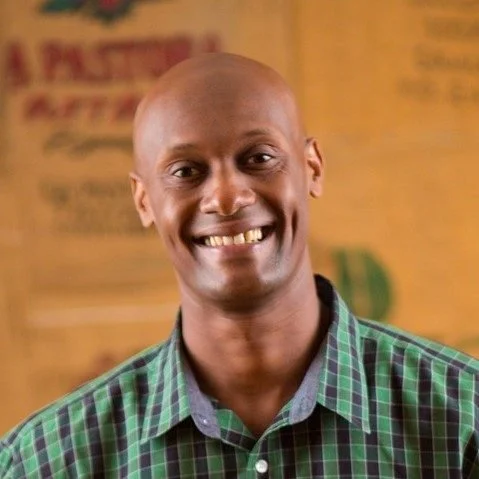
Arthur Karuletwa | La Colombe
During harvest season in colonial-era Rwanda, a strange ritual play out among the coffee trees. Officials would hand the village storytellers, the scribes, a small cup of concentrated coffee, wait until their hearts started pounding, then quietly offer them water. The scribes, convinced they had just survived something dangerous, spent decades warning their communities that coffee was a foreign medicine, unfit for local hands. Three laws reinforced the lie: grow the coffee, protect the tree, and leave the cup alone. The crop became the backbone of the economy while remaining, for the people who grew it, forbidden fruit.
That colonial history is the backdrop Arthur Karuletwa grew up against, coffee as the country’s economic engine and, at the same time, something local hands were never meant to touch. Today he is La Colombe’s VP of Sustainable Sourcing and Impact, the executive who decides which farms the company works with and how it traces a bag of beans back to the hands that picked it.
But his relationship with the crop started in a much darker place. Karuletwa survived the 1994 genocide in Rwanda, which killed a million people in a hundred days and took his own family with it. He doesn’t describe coffee as a cause of that violence. He describes it as evidence of the same pattern: people stripped of ownership over their own land and labor, told what to grow, what to touch, what to believe, until dignity itself erodes. “What is it about humanity that could turn so grotesque, it would mutilate itself to the scale of a million people in a hundred days?” he asked, the question that has driven much of his adult life.
Today he leads sourcing and traceability for La Colombe, the Philadelphia coffee roaster founded in 1994 and acquired in 2023 for $900 million by Chobani, the yogurt company built by Hamdi Ulukaya, an immigrant from Turkey who has made hiring refugees central to his business. Karuletwa’s role puts him, literally, between the fields where coffee is grown and the customers who drink it. But it took him years to get there. “I would say unfortunate consequences got me into coffee,” he said. “Actually, I detested coffee.”
His change of heart came from a theory about what had actually caused the violence around him. Karuletwa came to believe the genocide’s deepest engine was the erosion of self-worth, so complete that neighbors stopped recognizing each other as human. “That kind of pace and speed can only happen when the person in front of you is less than human, whereby you do not see a reflection of self in this individual,” he said. He started searching for the version of poverty that measures invisibility as sharply as it measures hunger, the kind no dictionary fully captures. “After losing a million people in a hundred days and a whole family, I decided to wage a war on poverty,” he said. “And coffee is my tool, is my weapon of choice.”
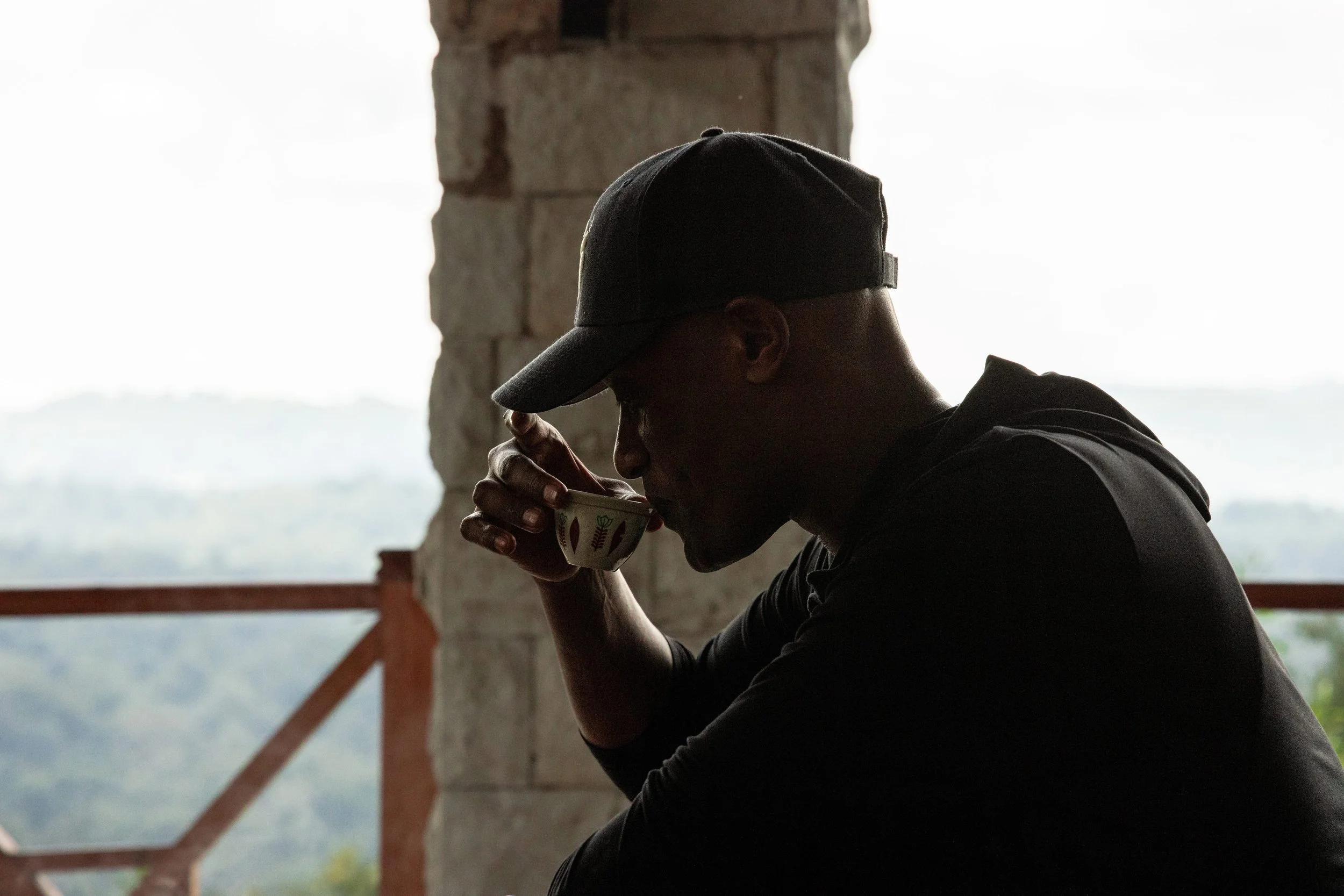
Arthur Karuletwa on Tega & Tula Coffee Farm in Ethiopia | La Colombe/Thomas Silcock
Finding the Price of Dignity
Karuletwa needed something concrete to fight with. Dignity itself had no price tag, he said, but identity, he discovered, did. The proof came from his own life. Arriving in the United States on a basketball scholarship, he was issued a student ID, a small plastic card he initially treated as standard-issue paperwork. When he forgot it one day, he was stopped at a cafeteria door while his teammates walked past him with a flash of plastic. “I ran back to my dorm room, got back, flashed it, and I walked in,” he said. “This thing yielded power.”
That card opened cafeterias, libraries, bank accounts, credit offers. It told institutions who he was and that he was worth something. Back home, he had gone by several names over the years, Mutijima, Mukama, Asa, each one loosely held, with a limited paper trail behind it to anchor a claim of accomplishment or credit. The difference, he realized, was traceability: a documented history that lets a person stake a claim to their own worth.
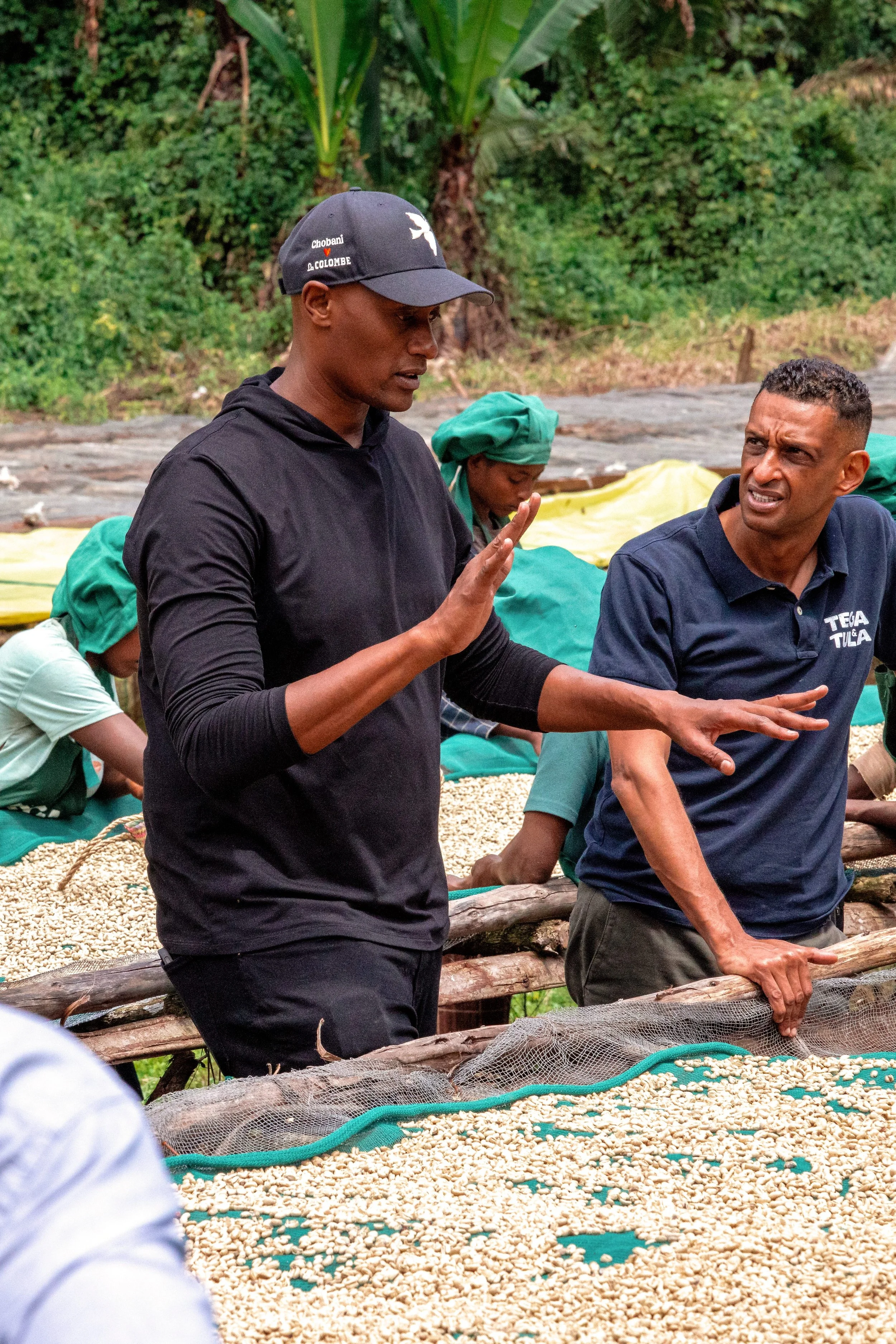
Arthur Karuletwa on Tega & Tula Coffee Farm in Ethiopia | La Colombe / Thomas Silcock
Farmer Jane, Lot 001
That insight became the operating principle behind La Colombe’s sourcing model. The company buys coffee from a name, a specific farmer, a specific lot. “Farmer Jane sells coffee to La Colombe, not ‘we just buy coffee from Rwanda’,” Karuletwa said. A farmer with a receipt bearing her name and lot number can walk into a bank and be taken seriously. “She immediately becomes bankable,” he said. “That’s when she says, I am somebody.”
The idea sounds simple. Executing it across more than thirty countries takes real infrastructure. Coffee supply chains are famously opaque, with layers of middlemen separating a smallholder farm from a customer’s cup. Karuletwa’s answer was to map the chain of custody at every step, insisting on what he calls having “our shadow on the soil,” close enough to a farm that he can physically reach out and touch the person who grew what’s in the bag. La Colombe pairs that proximity with what it calls an Informed Trade model, designed to shield farmers from swings in global commodity markets driven by forces entirely outside their control, oil prices half a world away, for instance.
A Dove, Not a Verdict

La Colombe is French for “the dove”. | La Colombe
La Colombe is French for “the dove,” a name that carries its own argument before Karuletwa says a word. Karuletwa draws a sharp line between what he calls a good coffee and a bad one. A good coffee, in his framing, tells the truth about the people and land behind it, flaws included. “It’s a lot deeper than what makes a good cup of coffee,” he said. The company’s approach, he said, borrowing from his CEO, is simple: “We always pull up a chair.”
That philosophy extends into the fields themselves, where La Colombe works with farmers on regenerative and agroforestry practices meant to protect both the land and the harvests that depend on it. Karuletwa points to changing rainfall patterns and shifting harvest calendars, the fact that grandparents once picked in March and their grandchildren now pick in April, as evidence that farming conditions are shifting in real time. With a severe El Niño season approaching, the company is prioritizing partnerships with farms already practicing biodiversity, betting that resilience built into the land now will matter more as conditions grow harsher.
What Karuletwa’s story ultimately argues is that traceability functions as a form of respect, and respect, applied at scale, becomes an economic strategy. A receipt with a farmer’s name on it, backed by a fair price, tells one specific person that their labor was seen and valued.
The bigger test is whether that model can hold as climate volatility accelerates and the countries La Colombe sources from face harsher, less predictable seasons. Karuletwa is treating the uncertainty as a design problem, building relationships now with the farms best positioned to withstand what’s coming. If the approach holds, the next generation of coffee growers in Rwanda and elsewhere may inherit something new: a cup of their own coffee, and a name on the receipt that proves it was theirs to sell.
At Conspiracy of Love, we help changemakers tell their most powerful stories — stories that inspire action, build movements, and create lasting impact.
Find out more about our Values-Driven Storytelling and GPS to Purpose workshops, and how we can help you scale your impact.