How The Green Renaissance Can Unlock A $4 Trillion Bio Economy

Leonie Weerakoon, Founder of Kinetik Ventures | Kinetik Ventures
For centuries, the ocean's secrets have compounded quietly — in the geometry of coral, in the root systems of mangroves, in the migration patterns of squid. These were not problems waiting to be solved. They were already solutions. The question humanity never thought to ask was: solutions to what?
Léonie Weerakoon has spent the better part of a decade asking exactly that.
The Blind Spot at the Center of the Global Economy
According to the World Economic Forum, the global bioeconomy — the commercial ecosystem built on biological processes, materials, and knowledge — is valued at $4 trillion today, with projections reaching $30 trillion by 2050. It underpins roughly half of all global GDP. And yet it has been treated as background noise rather than the signal itself.
Weerakoon trained as a human ecologist — a discipline sitting at the intersection of natural systems and human behavior — which gave her a vantage point that neither pure scientists nor conventional investors tend to occupy. She saw something they both missed: that the intelligence embedded in the world's most biodiverse regions wasn't just ecologically valuable. It was economically decisive. And almost none of it was being captured, protected, or translated into modern strategy.
So she built Kinetik Ventures, a research and intelligence platform, to do exactly that. The framework she developed is called the Green Renaissance — a convergence of ecological intelligence with modern technology that represents not just an environmental imperative, but an economic one.
"If you take nature's intelligence, which has evolved for 3.8 billion years, and merge that with some of our highest computing and technology that we have at our fingertips, including capital, then you can really build economic systems that compound over time instead of extracting value and collapsing."
The world has been running an extractive operating system. The Green Renaissance is a proposal for a different model entirely.
Islands as Living Laboratories
Kinetik's research engine is built around islands and coastal systems — places most institutions overlook, and precisely where Weerakoon believes the most valuable ecological data resides. Island nations are not peripheral to the bioeconomy. They are, in her framing, living laboratories housing concentrations of endemic species found nowhere else on Earth.
The intelligence embedded in those places is staggering. Mangrove root systems distribute force in ways now informing coastal infrastructure design. Squid movement has inspired medical devices. Coral geometry is being translated into new materials and architecture. Seaweed — used to make bags in historical records from Sri Lanka — is reemerging as the basis for bio-based pigments and alternative materials.
"A lot of nature's intelligence is about being able to endure geological timelines. Nature really teaches us how to design for durability and not just performance."
This is not biophilic design as aesthetic aspiration. It is operational logic extracted from systems stress-tested over billions of years.
The Investment Case Nobody Is Making
Some companies engaged through Kinetik’s research have already seen twenty times growth since their involvement began. The reason is not luck — it is intelligence. Kinetik doesn't just identify promising materials; it understands the cultural and ecological systems that produced them, giving investors a depth of context that conventional due diligence simply cannot replicate.
And yet the investment community has been slow to follow. Regenerative work gets filed under impact investing — a category carrying, in many institutional circles, the implicit assumption of below-market returns. Weerakoon finds this economically illiterate.
"There's still some stigma around investing in regenerative work that it is philanthropic, especially because it's simply tied to the environment. But the bioeconomy itself is currently valued at about $4 to $7 trillion — and that's going to only increase over the next 20 to 30 years."
These communities have historically received less than one percent of emerging market capital. The knowledge they hold may be worth far more than anyone in global finance currently understands.
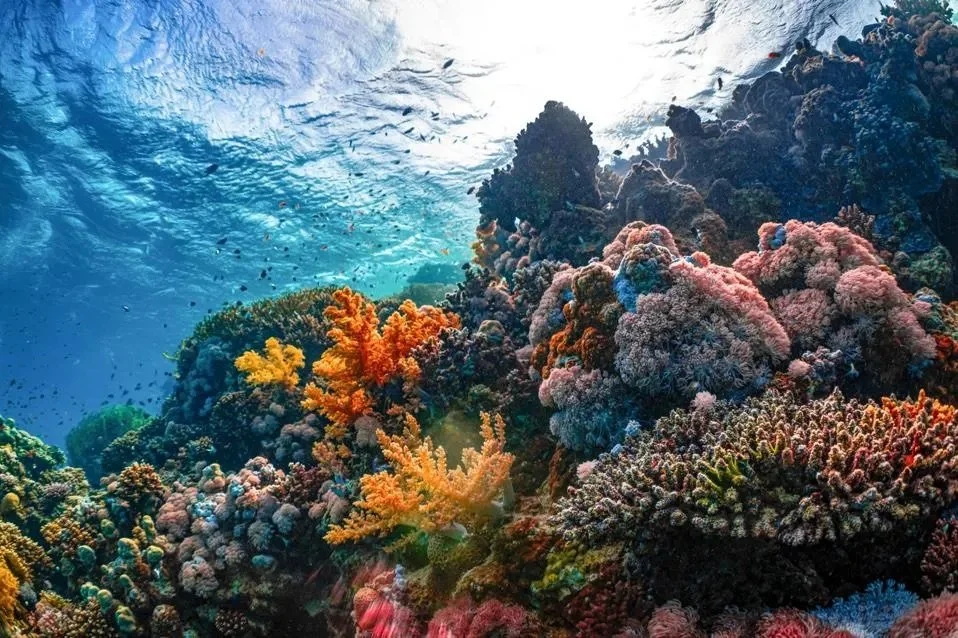
Kinetik's research engine is built around islands and coastal systems — places most institutions overlook, and precisely where Weerakoon believes the most valuable ecological data resides | Photo by NEOM on Unsplash
What AI Can't Replace
Kinetik uses AI as an accelerant — a way of compressing decades of pattern recognition into insight that institutions can act on. But Weerakoon is precise about what it cannot do.
"AI accelerates pattern recognition, but it doesn't replace ecological memory. We use AI to translate long-term intelligence into decision-grade insight."
The distinction matters. Nature's intelligence is not a dataset. It is a living archive accumulated over geological time — and the communities who hold it are not sources to be mined but partners whose sovereignty over that knowledge is non-negotiable.
Which is why the most consequential architecture Kinetik is building is ethical, not technological. "Parachute science" — institutions entering vulnerable communities, extracting indigenous knowledge, and returning with findings that benefit outside economies — is, Weerakoon says, endemic. Scientists and entrepreneurs routinely bypass governing structures to access communities directly, taking knowledge that may have existed within a single family for generations, with no accountability and no return to its source.
"These communities could easily be exploited, which is happening already. What we're trying to do is provide a very safe platform for all of this research to be done and accelerated."
Kinetik's response is a data sovereignty platform where nothing is shared without explicit permission from the communities and governments who hold the underlying knowledge. When value is created from that knowledge, the people who held it for centuries are the ones who benefit.
The Bet on Intelligence
"The intent is really to help elevate human consciousness, because history has shown that the exploitation of knowledge has really degraded culture, including our environments. The bioeconomy is really one of the only ways forward. This is a very lucrative space — and it is not just a vertical. It is a layer, just like AI is."
The Green Renaissance is not a bet on altruism. It is a bet on intelligence — the kind that has been running quietly, at depth, for billions of years, waiting for someone to finally listen.
At Conspiracy of Love, we help changemakers tell their most powerful stories — stories that inspire action, build movements, and create lasting impact.
Find out more about our Values-Driven Storytelling and GPS to Purpose workshops, and how we can help you scale your impact.